Free Shipping on US orders over $150
-
Collections
-
Bikini
- One Pieces
- Cover-Ups
- Men's
- Sale
- MODA GLAM x L'ANIMAL
- Nice Breed
-


Air-dry flat in the shade after pressing excess water out with a towel. That is the fastest safe method for drying swimsuits without damaging elastane or fading color. Two steps to do right now:
Pro Tip: Place the suit near a fan or open a window with good airflow. A fan can cut air-dry time significantly compared to still indoor air, with no heat risk.
Air-dry flat in the shade after a cold rinse and towel press — that single routine prevents the three main causes of swimsuit damage: UV fading, heat-induced polymer breakdown, and mechanical deformation.
| Point | Details |
|---|---|
| Rinse first, always | Cold water immediately after swimming removes chlorine, salt, and sunscreen before they degrade fibers. |
| Press, never wring | Roll the suit in a dry towel and press firmly; wringing stretches elastane permanently. |
| Flat in the shade | Lay the suit flat on a rack or towel, away from direct sun, to prevent UV fading and gravitational stretch. |
| Speed with airflow | A fan or dehumidifier cuts drying time safely; a hairdryer on cool setting is a last resort only. |
| Store dry, breathable | Never store a damp suit in a sealed bag; use a breathable drawer and rotate suits regularly. |
Follow this routine after every swim to keep shape, color, and stretch intact.
Rinse immediately. Hold the suit under cold running water for 30–60 seconds. This removes chlorine, salt, and sunscreen residue that would otherwise continue breaking down fibers while the suit dries. Textile scientists describe this as a chemical-maintenance step, not just a hygiene one. A textile scientist confirms that skipping this rinse allows chemicals to accelerate fiber decay even after you leave the water.
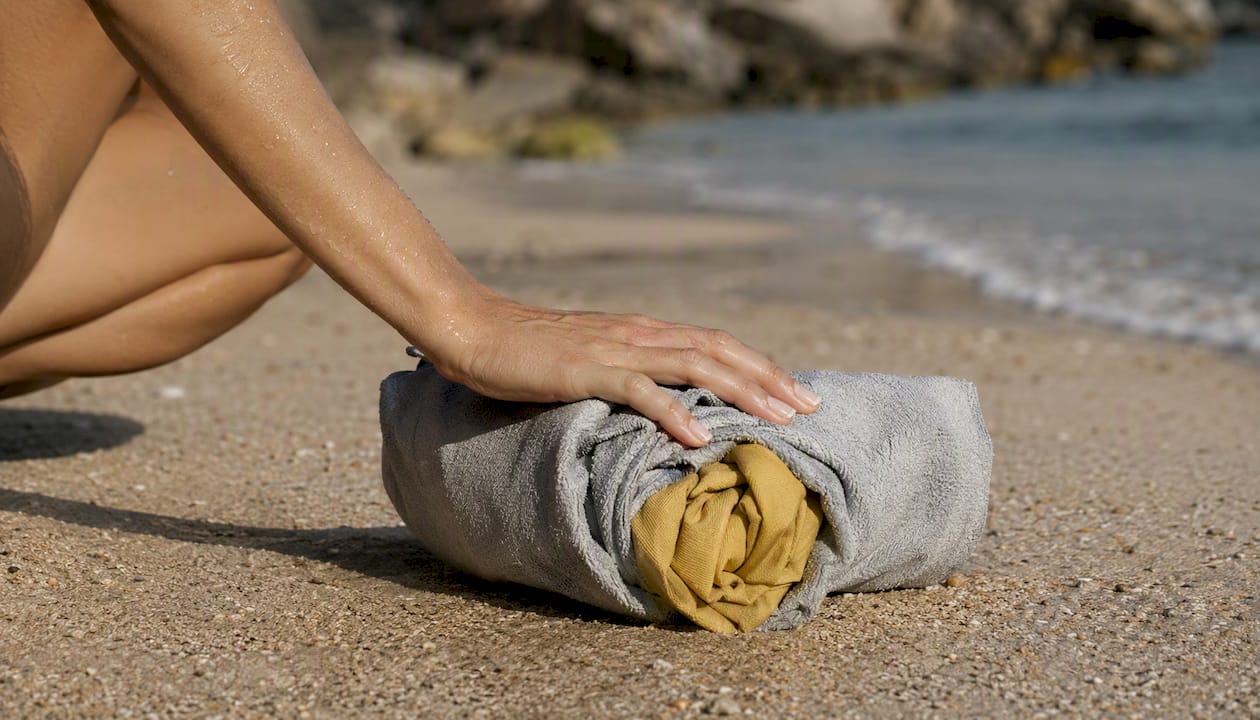
Remove excess water without wringing. Lay the suit flat on a clean, dry towel. Fold the towel over the suit and press down firmly with both hands. Roll the towel and suit together, then press again. Repeat with a second dry towel if the suit is still very wet. Fiber scientists at Good Housekeeping confirm that wringing places uneven stress on elastane fibers, while the towel-roll press is gentler and more effective.
Choose the right drying surface. Lay the suit flat on a clean towel or a mesh drying rack. If the fabric is color-sensitive or printed, turn it inside out first. Never hang a wet suit by its straps or waistband.
Position for airflow. Place the rack or towel in a shaded, well-ventilated spot indoors or outside. A bathroom with the exhaust fan running, a laundry room near an open window, or any room with a fan pointed at the suit all work well.
Leave it undisturbed until fully dry. Depending on humidity and airflow, most suits air-dry in 1–3 hours indoors with a fan, or 2–4 hours in still air. Check that the lining and any padded cups are completely dry before storing.
Warning: Never use a tumble dryer, hot water, or a heated drying rack. Do not wring the fabric. These actions warp elastic components, shrink linings, and permanently reduce fit.
Sometimes you need a suit ready by morning. These low-risk methods speed drying without heat damage.
For travel, carrying a second suit solves the problem entirely. If you only have one, packing a thin microfiber towel gives you a fast water-removal tool at the pool or beach before you even get back to your room.
Pro Tip: A microfiber travel towel absorbs water faster than a standard cotton towel and wrings out quickly, so you can repeat the press method twice in under two minutes.
Most swimsuit damage is avoidable. These are the errors that cause it.
Irreversible consequences of repeated heat, sun, and mechanical stress: loss of stretch, permanent sagging, color fading that cannot be reversed, thinning fabric, and mildew staining that does not lift.
Getting the suit clean before drying prevents odors and stains from setting permanently.
Decide: rinse only, hand-wash, or machine-wash. Check the care label first. Most designer swimwear specifies hand-wash only. If the label is silent on machine washing, default to hand-wash.
Hand-wash method. Fill a basin with cold water and add a small amount of mild detergent formulated for delicates. Gently squeeze the suit through the water for 1–2 minutes. Do not scrub or twist. Rinse thoroughly until no soap remains.
Sunscreen and oil stains. Apply a small drop of mild dish soap directly to the stain before washing. Work it in gently with your fingertips, let it sit for 2–3 minutes, then rinse. Treat stains before the suit dries; heat sets them permanently.
Chlorine odor. Add one tablespoon of white vinegar to the rinse water. Vinegar neutralizes residual chlorine smell without damaging fabric. Rinse again with plain cold water after.
Lined suits and padded cups. Press the lining and cups gently during washing. Remove removable pads and wash them separately. Lay both flat to dry and check that the cups are fully dry before reassembling.
Pro Tip: Cold water is the correct temperature for every step: rinse, wash, and final rinse. Even lukewarm water begins to soften and weaken elastic components over repeated cycles.
Proper storage extends the life of a suit that has been dried correctly.
Signs it is time to replace a suit:
Mild odor that returns after washing usually means chemical residue is still present. An extra cold-water rinse with vinegar often resolves it. Limp elastics, by contrast, are a structural failure and cannot be reversed.
The recommendations above are grounded in textile science, not convention.
Elastane and polyamide, the two fibers in most swimwear, are both vulnerable to UV radiation, chlorine, and heat. UV exposure alters the molecular structure of dye compounds, causing visible fading, and simultaneously weakens the polymer chains in elastane that give the fabric its stretch. Textile fiber research confirms that combined UV and chlorine exposure accelerates fiber strength loss faster than either agent alone. The Library of Congress color science resource supports this: UV radiation directly disrupts the chemical bonds responsible for color stability in dyed textiles.
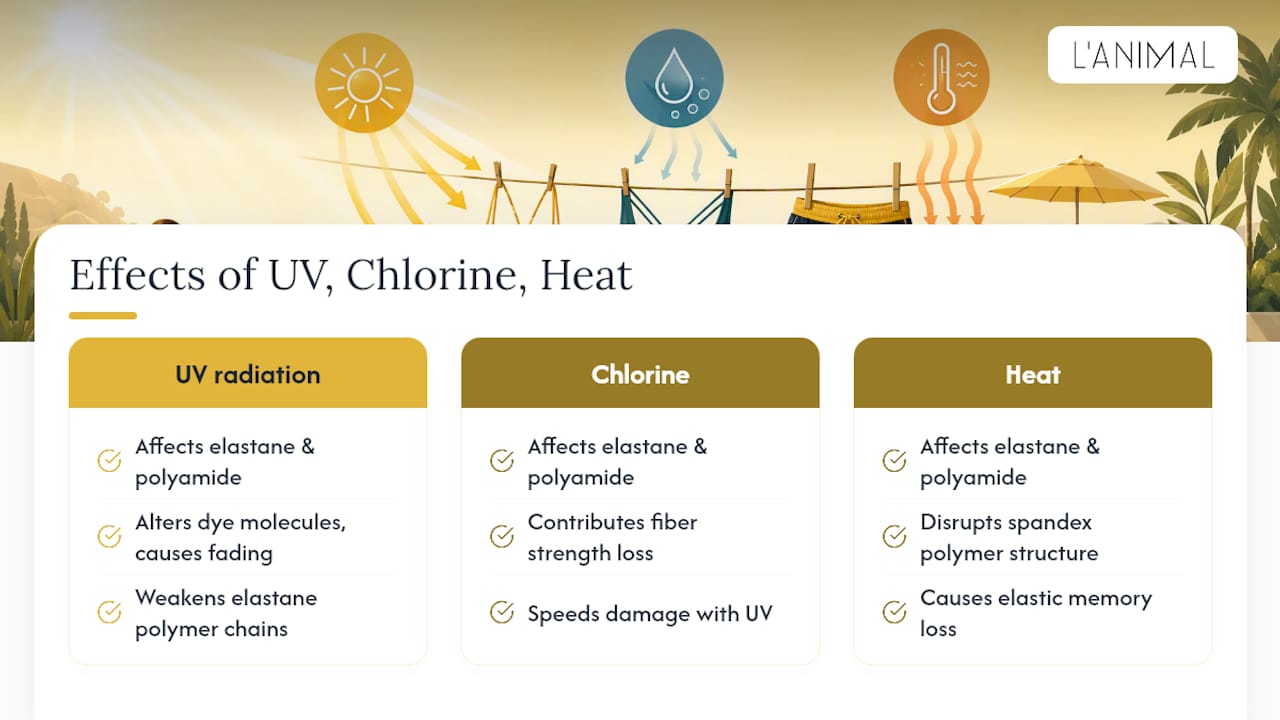
Heat from a dryer compounds the problem differently. High temperatures disrupt the polymer structure of spandex, causing the fibers to lose their elastic memory. Once that memory is gone, the suit does not recover its original shape.
Mechanical stress, specifically wringing and hanging, adds a third failure mode. Wet elastane is more vulnerable to permanent deformation than dry elastane. Twisting or suspending a water-heavy suit places concentrated load on specific fiber groups, stretching them beyond their recovery threshold.
Air-drying flat in the shade addresses all three risks at once: no UV, no heat, no gravitational load on wet fibers.
Every Lanimal piece is designed with a specific silhouette in mind. The cut, the fabric tension, the way a bottom sits or a top supports — all of it depends on the elastane behaving exactly as it was engineered to. Proper drying is not a secondary concern. It is what keeps the suit performing the way it was made to perform, season after season.
The difference between a suit that lasts two summers and one that loses its shape after six weeks almost always comes down to how it was dried and stored. Rinse it, press it, lay it flat in the shade. That routine takes three minutes and protects the investment entirely.
For more on caring for your Lanimal pieces, the Lanimal blog covers quality, longevity, and what to look for in swimwear that holds up. And if poolside style is on your mind beyond the suit itself, Dan Flashes’ poolside styling guide is worth a look.

Lanimal designs swimwear built to last. Browse the full Lanimal collections and find pieces worth caring for, including the Sportif Bikini Bottom, one of the brand’s most requested styles.


