Free Shipping on US orders over $150
-
Collections
-
Bikini
- One Pieces
- Cover-Ups
- Men's
- Sale
- MODA GLAM x L'ANIMAL
- Nice Breed
-


An influencer collection is a product line or curated product set launched by a brand in partnership with a creator, designed to turn that creator’s audience trust into a direct commerce event. The format ranges from a fully co-designed capsule drop, where the creator shapes the product itself, to a curated edit, where the brand packages existing SKUs under the creator’s name. Either way, the core components are the same: a defined level of creator involvement, a specific product or curation type, a distribution model (limited drop or full catalog), and a primary business objective such as sales, new-customer acquisition, or first-party data capture.
The essential elements of any influencer collection:
A capsule drop, for example, is a small, time-limited set of products designed with a creator and released on a fixed date. A curated edit, by contrast, packages existing products under the creator’s name with minimal production lead time. Lanimal runs both formats, pairing designer swimwear with online fashion influencers to create collaboration collections that carry the brand’s editorial aesthetic while leveraging each creator’s native audience.
An influencer collection converts creator trust into a measurable commerce event when the format, compensation, IP terms, and KPIs are defined before production begins.
| Point | Details |
|---|---|
| Definition and formats | An influencer collection is a creator-linked product line or curated set; main formats are co-created capsule drops, curated edits, and ambassador mini-collections. |
| Timeline and planning | Co-created drops typically run 6–18 months; curated edits can compress to 6–12 weeks with fewer SKUs and a pre-order model. |
| IP and compensation | Brands typically retain product IP; creators license name and likeness; hybrid compensation (advance plus royalties or revenue share) is standard for co-created drops. |
| Measurement priorities | Track ROAS, CAC, sell-through rate, and repeat purchase rate; wire UTM links, affiliate codes, and unique landing pages before launch. |
| Lanimal | Lanimal runs collaboration collections pairing Lital Simel-Rhedrick’s swimwear designs with online fashion influencers, structured as limited drops with measurable sell-through and ROAS targets. |
The format varies considerably depending on the brand’s goals and the creator’s involvement. Three patterns appear most often.
Capsule or co-created product drops are the most integrated format. A brand and creator develop a small set of original or modified products together, set a launch date, and release them as a limited-edition event. The scarcity creates urgency; the creator’s involvement creates authenticity. According to Later’s collaboration guide, co-created products sit at the top of the collaboration depth spectrum, acting as both a product launch and a content moment. Well-seeded drops also attract press and editorial coverage, extending reach well beyond the creator’s native following.
Curated edits or “influencer picks” require far less production time. The brand selects existing SKUs, groups them under the creator’s name, and builds a dedicated landing page or collection page. The creator promotes the edit as their personal selection. For a swimwear brand like Lanimal, this might mean a creator choosing her favorite influencer swimwear picks from the existing catalog and presenting them as a vacation edit. Turnaround can be as short as a few weeks.
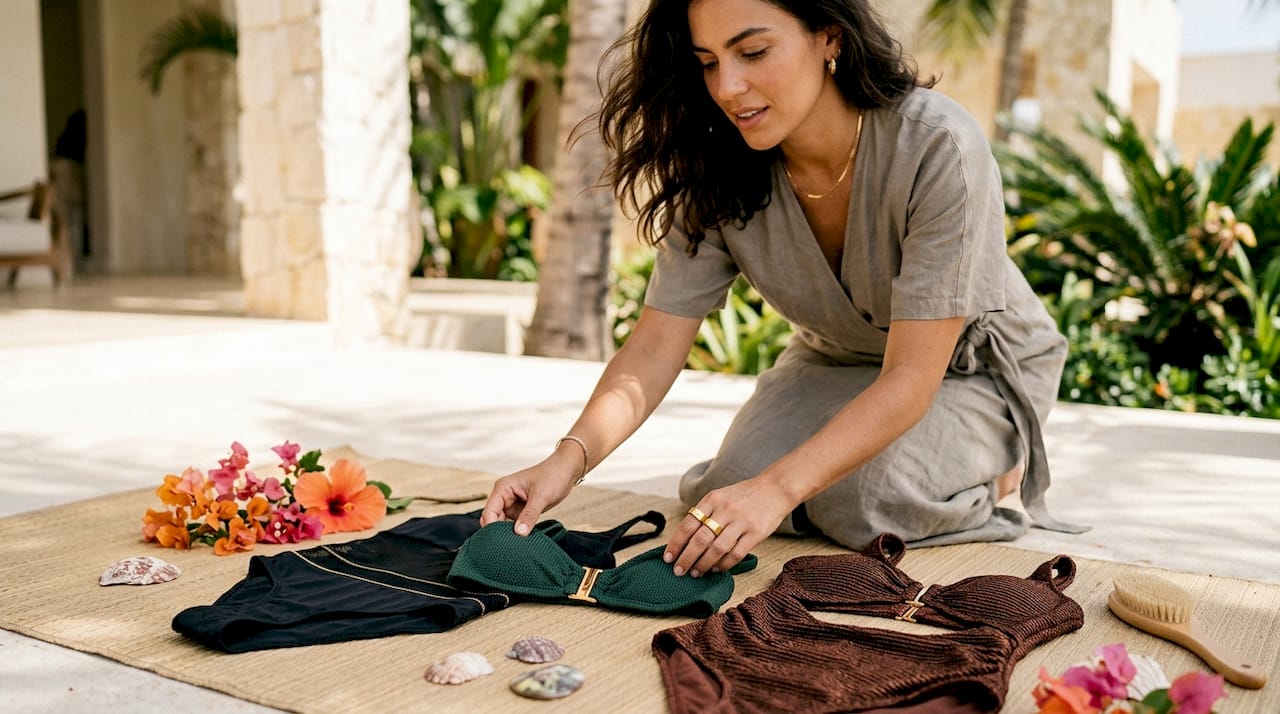
Merch or artist collaborations are common among niche creators with highly loyal audiences. These are typically small-batch, high-authenticity runs, often with hand-drawn graphics or unique colorways, where the creator’s personal brand is the primary draw. The audience buys because of who made it, not just what it is.
Each format serves a different audience relationship and a different business goal, which is why choosing the right type before production begins matters as much as the creative itself.
HubSpot’s influencer marketing overview makes clear that the depth of a collaboration determines its timeline, compensation structure, and operational complexity. Four types cover most of what brands actually run.
| Collection Type | Creative Control | Speed to Market | Inventory Risk | Content Volume |
|---|---|---|---|---|
| Co-created capsule drop | Shared (brand + creator) | 6–18 months | High (original production) | High |
| Influencer-curated edit | Brand-led | 6–12 weeks | Low (existing SKUs) | Medium |
| Merch / artist collab | Creator-led | 3–6 months | Medium (small batch) | Medium |
| Ambassador mini-collection | Brand-led, creator-approved | 4–8 weeks | Low to medium | High |
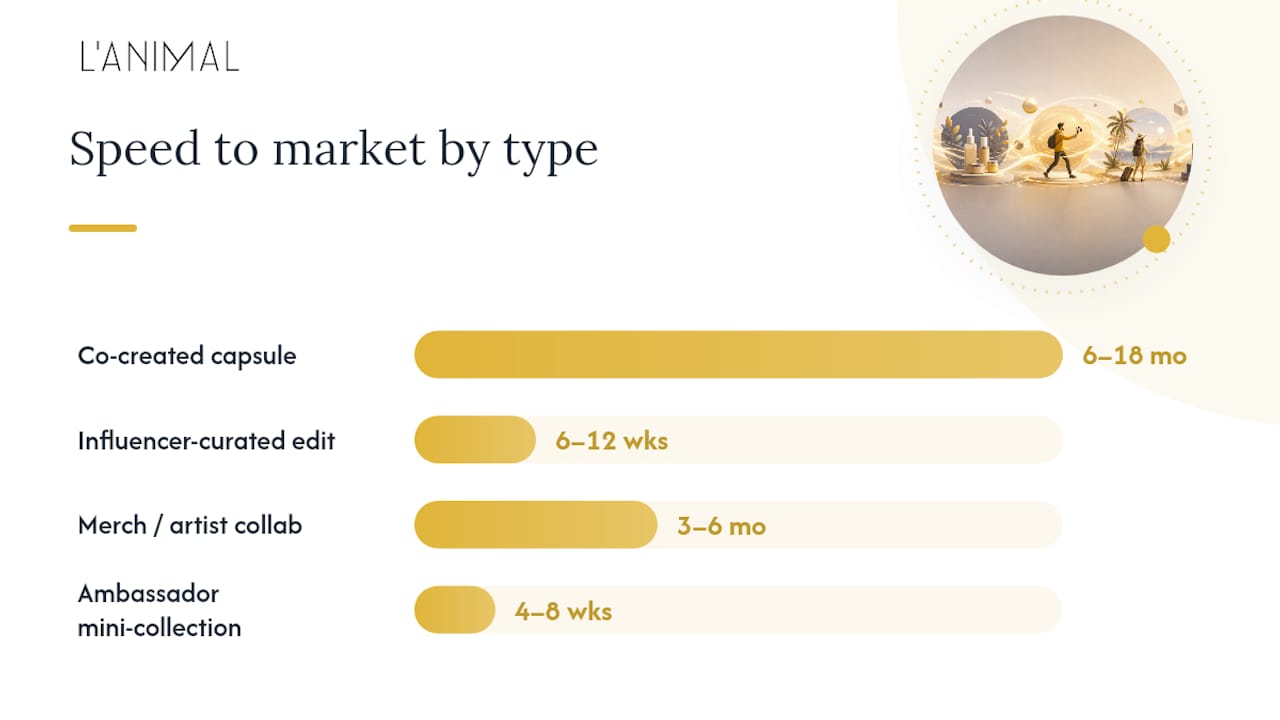
Co-created capsule drops give the creator real design input and produce the most differentiated product, but they carry the longest lead times and the highest inventory exposure. Curated edits are the fastest to market and carry the least risk, but they generate less press and less product differentiation. Merch and artist collaborations work best when the creator has a distinct visual identity their audience already associates with a specific aesthetic. Ambassador mini-collections sit in the middle: the brand controls the product, but the creator’s approval and promotion give it a personal endorsement layer.
Pro Tip: Choose the format based on your primary objective. If the goal is brand-building and press coverage, a co-created capsule drop justifies the longer timeline. If the goal is direct revenue with minimal production risk, a curated edit or ambassador collection gets you there faster.
The business case is straightforward from both sides, and Sprout Social’s influencer marketing primer identifies audience trust as the primary reason creator recommendations move purchasing decisions. That trust is what separates a collection from a standard product launch.
For brands, the benefits include:
For creators, the benefits include:
The content production benefit deserves specific attention. Influencer Marketing Hub notes that co-designed capsule collections become infrastructure assets: the campaign imagery, UGC, and paid creative generated during the launch get repurposed across product detail pages, email flows, and affiliate catalogs long after the drop closes. A single collection launch can supply a brand’s content calendar for months.
Later’s 2026 playbook confirms that brands are structuring drops specifically to deliver measurable outcomes like ROAS and customer acquisition cost, not just awareness. The shift is significant: collections are now treated as repeatable acquisition channels, not one-off events.
Every collection involves at least four operational roles: the brand’s product or merch team, the creator acting as creative director or curator, a production or fulfillment partner, and a marketing or paid media lead. Larger drops add a PR or seeding coordinator.
Compensation models vary by partnership depth:
On IP, Influencer Marketing Hub’s capsule collection guide documents the standard arrangement: brands retain product design IP while creators license their name and likeness for a defined period and set of uses. Rare exceptions involve high-profile creators who negotiate partial co-ownership of unique creative IP, but this is not the norm.
Contract clauses that brands and creators should address in writing: approval gates and revision rounds, exclusivity windows (category and duration), usage rights for campaign imagery and UGC, territory scope, collection duration, and unsold inventory handling (markdowns, returns, or destruction).
Pro Tip: Creators should negotiate a performance upside, such as a royalty or revenue share tier, rather than accepting a flat fee alone on a co-created drop. Brands should cap the royalty period and tie it to net revenue, not gross, to protect margin.
A typical co-created capsule drop runs 6–18 months from concept to delivery. Simpler curated edits or pre-order models can compress to 6–12 weeks with fewer SKUs, as Influencer Marketing Hub’s timeline guidance notes. The planning steps below apply to both, with the longer timeline items flagged.
Operational risks to address early: MOQ commitments before sales data exists, fulfillment capacity during a spike, and campaign calendar conflicts with other brand launches.
Pro Tip: Design the launch so every content asset serves multiple purposes. A single shoot day can produce product page imagery, paid social creative, email header visuals, and organic posts. Brief the creator and photographer on all required formats before the shoot, not after.
Measurement starts before launch, not after. Ecommerce KPI guidance from Affinsy identifies ROAS, CAC, average order value, and sell-through rate as the primary metrics for evaluating whether a collection achieved its commercial goals.
Primary KPIs:
Secondary KPIs:
Tracking setup: Every traffic source needs a unique UTM parameter. Every creator needs a unique affiliate code or discount code. The collection should have its own landing page with its own pixel event, separate from the main catalog. Attribution windows for influencer-driven commerce typically run 7–30 days, depending on the product’s consideration cycle.
A common measurement pitfall is attributing all collection revenue to the creator’s posts while ignoring the paid media amplification running simultaneously. Separate the organic and paid attribution windows in your analytics to get an accurate read on each channel’s contribution. Ecommerce success metrics guidance recommends tracking revenue by channel from day one rather than reconciling it after the launch window closes.
Most collection failures trace back to one of four operational problems: unrealistic timelines, poor MOQ planning, weak fulfillment, or a creator whose content style doesn’t match the product.
Common operational pitfalls:
Legal and ethics issues to address:
Red flags in partnership negotiations:
Consult qualified legal counsel before finalizing any influencer collection contract that involves IP licensing, revenue share, or exclusivity clauses.
Lanimal’s collaboration workflow is built around concept alignment first. Before any design work begins, designer and stylist Lital Simel-Rhedrick meets with the creator to establish the collection’s aesthetic direction, the SKU count, and the target customer. That alignment session determines whether the collaboration becomes a co-created capsule or a curated edit from the existing catalog.
The process flow:
Success for Lanimal looks like a sell-through rate that justifies the production run, a ROAS that exceeds the brand’s baseline paid media benchmark, and a cohort of new customers whose repeat purchase behavior is tracked over the following 90 days.
Lanimal’s collaboration collections are designed to function as both a product launch and a content production event — every shoot, every fitting, and every creator post is planned as a reusable asset from the start.
Pro Tip: If you are a creator considering a collaboration with a swimwear brand, ask to see the production timeline and MOQ commitments before signing. A brand that cannot answer those questions clearly is not ready to run a collection.
Most brands still brief influencer collections the way they brief a sponsored post: here is the product, here is the talking point, here is the go-live date. That framing produces content. It rarely produces a collection that converts.
The difference is in how the brief is written. A campaign brief optimizes for impressions and engagement. A product launch brief optimizes for sell-through, CAC, and repeat purchase. Those are different documents, and they produce different creative decisions. When a creator knows the margin target and the sell-through goal, they make different choices about how to present the product, which audience segments to address, and how to structure the content calendar.
The trade-off is real: tighter commercial constraints can compress creative freedom. But the collections that consistently outperform are the ones where the creator understood the business objective well enough to make creative choices that served it. Authenticity and unit economics are not opposites. They require the same thing: a brief specific enough to give the creator something real to work with.
Lanimal builds influencer collaboration collections from concept through launch, with Lital Simel-Rhedrick leading the creative direction at every stage. The process covers concept alignment, design iterations, small-batch production, and launch support including paid media activation. Collections are structured as limited drops, with pre-launch waitlists and creator-led content planned as multi-purpose assets from the start.
Readers interested in the product quality behind Lanimal’s collaborations can start with the Sportif Bikini Bottom, a piece that reflects the brand’s editorial aesthetic and the standard of construction applied across every collection. For brands or creators ready to discuss a collaboration, the next step is reaching out through Lanimal’s contact page to schedule a brief intake conversation.
The following sources informed this article and offer deeper reading on specific topics:


