Free Shipping on US orders over $150
-
Collections
-
Bikini
- One Pieces
- Cover-Ups
- Men's
- Sale
- MODA GLAM x L'ANIMAL
- Nice Breed
-


Swimwear detailing is the full set of design and construction choices — seams, linings, trims, hardware, ruching, elastic placement, and embellishments — that determine a swimsuit’s fit, finish, and aesthetic. These choices are not decorative afterthoughts. They control opacity, edge recovery, silhouette, and how a piece holds up after repeated use. Designers like Lital Simel-Rhedrick at Lanimal specify every element in a tech pack before a single sample is cut, using technical flats, a bill of materials, stitch callouts, and an elastic map to prevent misinterpretation during production.
Swimwear detailing — the full set of seam, lining, elastic, hardware, and trim choices — is the primary determinant of how a suit fits, recovers, and lasts.
| Point | Details |
|---|---|
| Encased elastic is the top quality signal | Look for “fully encased” in the spec line; exposed elastic rolls and degrades faster. |
| Fabric composition matters | Nylon-elastane blends with a moderate amount of elastane offer balanced stretch and recovery. |
| Hardware specs belong in the description | Alloy type and coating determine corrosion resistance and long-term finish. |
| Inside-out photos reveal true construction | Request one if not listed; clean seam finishing is the clearest indicator of build quality. |
| Lanimal specifies every detail before sampling | One lead detail and one supporting detail per style, locked in the tech pack before production. |
Swimwear construction details fall into six functional categories. Each one signals something specific about fit and build quality.
Pro Tip: When reading a product page, look for the word “encased” next to any elastic callout. That single word separates a detail that will hold its shape from one that will not.
Ruching softens and redistributes visual volume. The elastic tension beneath the gathering pulls fabric inward, which can improve fit across a range of body shapes — but only when the anchoring is secure at both ends. Loose anchoring causes the gather to migrate during wear.
Cut-outs increase visual interest but require the designer to redistribute support to adjacent panels. A bust cut-out, for example, shifts tension to the straps and side seams. Shoppers should check that strap width and seam reinforcement are proportional to the size of the opening. Styles with large cut-outs that also carry minimal strap width are a structural trade-off worth noting before purchase.
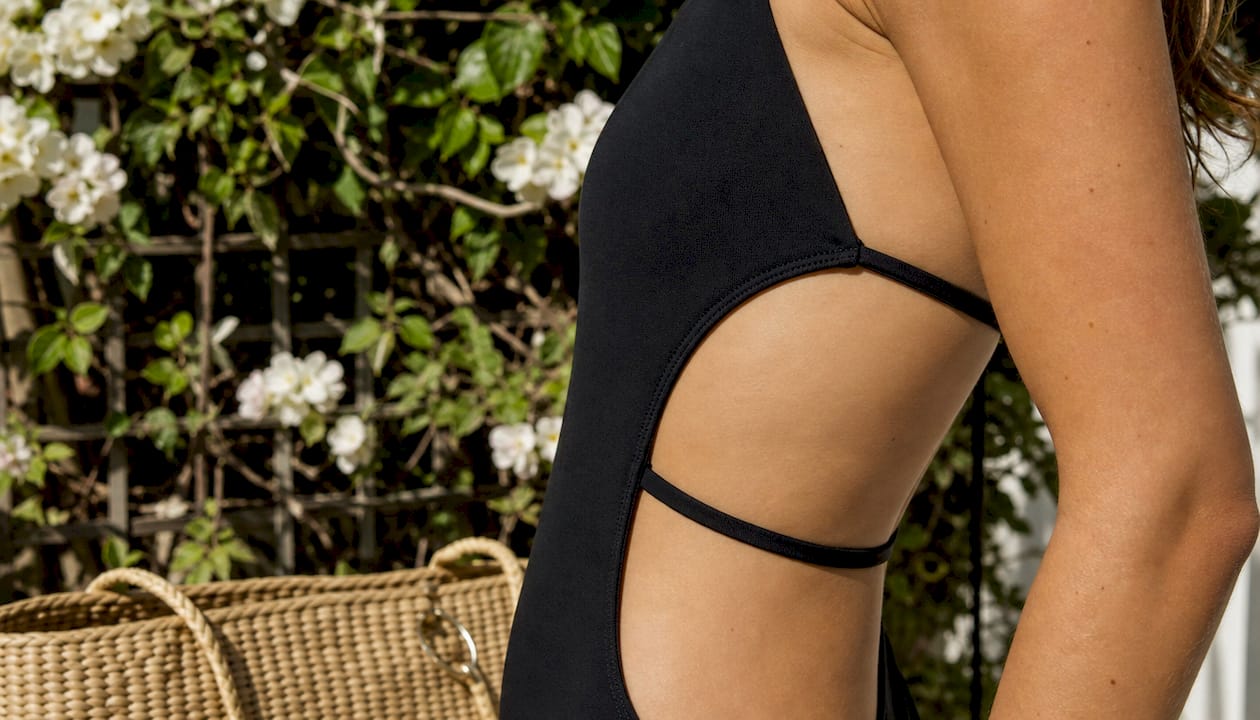
Hardware placement affects both silhouette and comfort. A side-ring detail at the hip draws the eye outward and can widen the visual line. Heavy hardware in a high-stretch zone — like a center-front slider on a bandeau — can distort the fabric over time because the metal resists the stretch the fabric needs to recover.
Lining choice is the least visible detail and one of the most consequential. A tricot lining adds a second layer of opacity and structure. Power mesh concentrates compression. A suit with no lining callout in the product description is worth questioning directly.
Pro Tip: Check gathering symmetry in product photos by looking at both sides of a ruched panel. Uneven depth from left to right in a flat-lay photo often means the elastic tension was not consistent — and that asymmetry will be more pronounced on the body.
Three practical tests separate a one-season suit from a durable one, and two of them work from photos and product descriptions alone.
Industry guidance favors nylon-elastane blends with explicit percentage listings — high-nylon compositions with 18–22% elastane are a common benchmark for balanced stretch and recovery. A label that lists only “polyester/spandex” without specific fiber percentages gives you less information to evaluate.
For an in-store or at-home check, pull the fabric approximately 3–4 cm at a seam, hold for three seconds, and observe the recovery speed. Recovery under three seconds is a favorable indicator of durability.
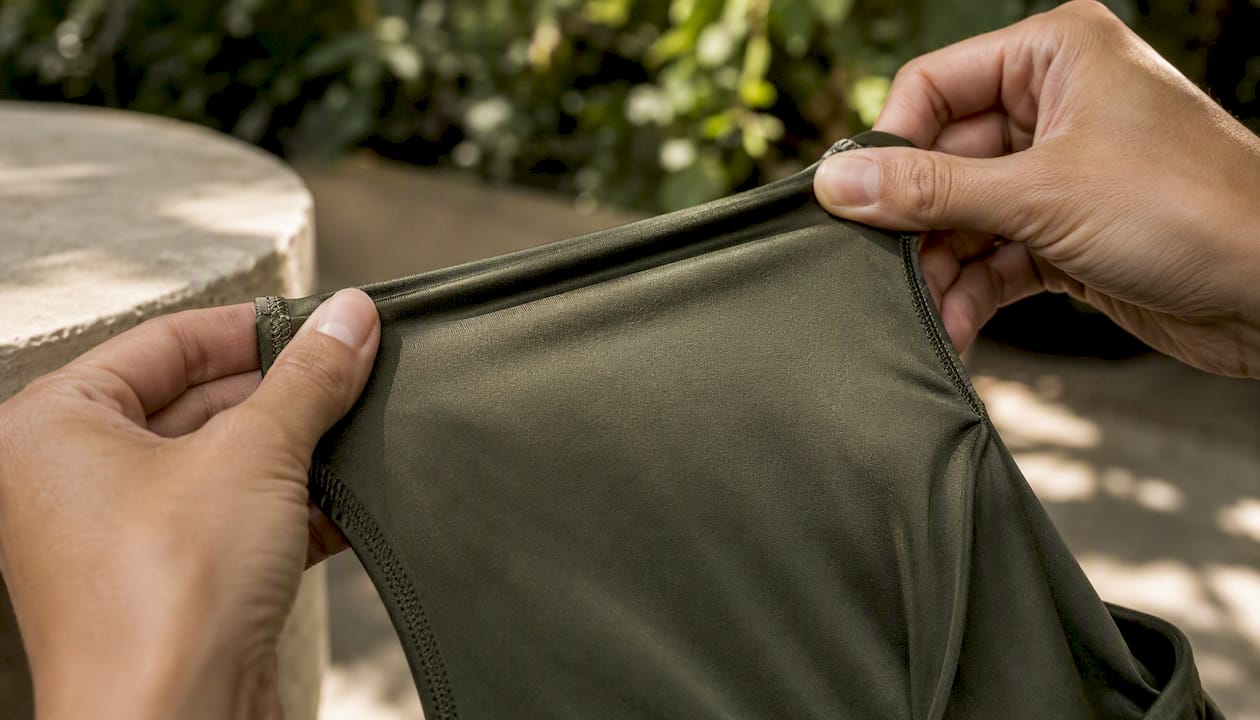
Pro Tip: Zoom into hardware detail shots and look for a consistent surface finish with no visible casting lines or rough edges. Rough edges on a ring or slider indicate lower-grade metal finishing and will wear through fabric faster.
Three photo types give you the most information fastest: a close-up of the seam interior, a flat-lay showing the full piece, and a hardware detail shot. If a brand does not provide all three, ask.
Read product spec lines for these specific callouts: elastic width (in millimeters), lining type (tricot, power mesh, or none), hardware material and coating, and any explicit construction notes like “fully encased” or “bound seam allowance.” Vague language like “quality lining” without a material name is not a spec — it is marketing copy.
When spec lines are incomplete, contact customer service with direct questions. Two that consistently surface useful answers:
Pro Tip: Ask for an inside-out photo if one is not listed. Brands with clean interior construction are almost always willing to share it. Brands that decline rarely have a finish worth the price.
| Term | What to look for in photos or descriptions |
|---|---|
| Encased elastic | “Fully encased” in spec line; no visible elastic band at edges |
| Power mesh | Named in lining callout; visible as a firmer panel in close-up |
| Coverstitch | Parallel double-stitch lines visible on hem in close-up photo |
| O-ring / Slider | Hardware detail shot showing finish and weight |
| Grading tolerance | Multi-size fit notes or size-specific measurement tables |
Lanimal’s design process, led by founder and designer Lital Simel-Rhedrick, starts with a clear decision: one lead detail and one supporting detail per style. That constraint keeps the construction focused and prevents overdesign that would compromise fit or production consistency. From there, the process moves through technical flats, a bill of materials, stitch callouts, and an elastic map — each element locking in a specific fit or finish outcome before sampling begins.
The Sportif Bikini Bottom is a concrete example of this approach. The style’s defining details are specified at the tech-pack stage, with elastic placement and seam finishing confirmed across multiple sample sizes before production approval.
Lanimal’s pre-production checklist covers:
The brand’s collection planning and workflow is documented publicly, which gives shoppers direct visibility into how design decisions translate to production standards. For a deeper look at how those standards apply to men’s styles, the men’s swimwear workflow post covers the tech-pack-to-production steps in detail.
Use this list when comparing two or three listings side by side.
Sample message to customer service — construction: “Could you confirm whether the leg opening elastic is fully encased, and share an inside-out photo of the seam finishing?”
Sample message — hardware: “What alloy and coating is used for the ring/clasp hardware? Is it tested for corrosion resistance?”
The conventional view is that detailing is about aesthetics — that a ring detail or ruched panel is a styling choice. That framing misses the structural function those details carry. A side O-ring does not just look good; it determines how strap tension distributes across the torso. Ruching is not just texture; it is an elastic-tension system that either holds or fails at the anchoring points.
What shoppers underestimate is how much a single under-specified detail can cascade. An elastic width that is not locked in the tech pack gets substituted during production. That substitution changes tension, which changes fit, which changes how the entire garment wears. Lanimal’s approach — one lead detail, one supporting detail, fully specified before sampling — exists precisely to prevent that cascade. It is not a creative limitation. It is how a detail stays intentional from sketch to finished piece.
The practical takeaway for shoppers: when a brand publishes its quality and value reasoning openly, that transparency is itself a construction signal. Ask for the specs. Ask for the photos. A brand confident in its detailing will answer both.
Lanimal designs each piece around the construction principles covered in this guide — encased elastic, specified hardware, and seam finishing that holds across a size range. The Sportif Bikini Bottom is a direct example: close-up product photography and technical descriptions let you inspect the construction before you buy. For a broader view of detail-led styles across the full range, the collections page shows the current lineup with the same level of product photography.
Browse the Sportif Bikini Bottom and the full Lanimal collections to see how each detail described in this guide appears in practice. Product pages include close-up photography and spec callouts so you can evaluate construction directly.


