Free Shipping on US orders over $150
-
Collections
-
Bikini
- One Pieces
- Cover-Ups
- Men's
- Sale
- MODA GLAM x L'ANIMAL
- Nice Breed
-


Body positivity in swimwear is defined as the practice of celebrating all body types through inclusive representation, fit-focused design, and messaging that rejects narrow beauty standards. This movement matters because swimwear is one of the most emotionally loaded categories in fashion. Women are expected to show more skin, face more scrutiny, and feel more exposed than in almost any other clothing context. Research from 2026 confirms that body-positive advertising measurably improves mood, body satisfaction, and self-appreciation compared to thin-ideal content. Brands like Rem Blair and Sidway have built their identities around this principle, and the psychological evidence now backs what many women already knew intuitively.
The psychological case for body-positive swimwear representation is no longer theoretical. A 2026 study published in Frontiers in Psychology found that brief exposure to body-positive ads increased positive mood, body satisfaction, and body appreciation in young women, while thin-ideal advertising produced the opposite effects. This finding holds across both Western and Asian cultural contexts, which means the benefit is not limited to one demographic or beauty standard.
The mechanism behind this is self-objectification reduction. When women see bodies like their own presented positively, they are less likely to evaluate themselves as objects to be judged and more likely to experience their bodies as capable, present, and worthy. That shift in perspective is not cosmetic. It changes how a woman moves through a beach, a pool, or a social setting.
“Body-positive posts reduced self-objectification whereas thin-ideal ads had opposite effects.” — Frontiers in Psychology, 2026
A separate 2026 randomized study published in Springer involving 197 women aged 18 to 35 confirmed that body-positive images increased positive mood regardless of whether participants had a history of emotional abuse or bullying. This is a significant finding. It dismantles the assumption that body positivity only benefits women who already feel confident. The psychological lift is broad and consistent.
Brand-sponsored body-positive content also outperforms influencer-driven commercial content in terms of consumer acceptance. Brand-sponsored body positivity ads are more positively received and generate stronger psychological impact, which means the responsibility sits directly with swimwear brands, not just individual creators.
Fit matters more than size. A 2026 article in Brainz Magazine explains that proper swimwear design removes constant bodily attention, allowing a woman to be present rather than preoccupied with adjusting, covering, or monitoring her body. Confidence does not come from wearing a smaller size. It comes from wearing something that disappears into the background and lets you simply exist.

Traditional sizing templates were built on a narrow range of body proportions. They do not account for differences in torso length, bust size, hip-to-waist ratio, or shoulder width. A woman wearing her “correct” size in a poorly designed swimsuit will still spend the afternoon pulling at straps and second-guessing her reflection. A woman in a well-fitted piece, even in a larger size, will not.
Pro Tip: When shopping for swimwear, prioritize adjustability over aesthetics. Tie-side bottoms, adjustable straps, and underwire options with multiple hook positions give you control over fit that no standard sizing chart can provide.
Key design features that support genuine body confidence include:
Design must move beyond simple size scaling. Proportion, movement, and coverage are the real variables that determine whether a swimsuit supports confidence or undermines it.
Not all body-positive campaigns deliver equal results. A 2026 Penn State study involving 381 women found that self-discrepancy dampened positive affect when women viewed body-positive content that did not reflect their own body type. In plain terms: representation benefits are greatest when the viewer sees a body that resembles her own. Campaigns featuring only one version of “body positivity” still exclude the majority.
This has direct implications for swimwear marketing. A campaign that shows only hourglass plus-size bodies still excludes women with straight figures, athletic builds, petite frames, or visible disabilities. The psychological benefit of inclusive representation requires actual variety, not just a token departure from the thin ideal.
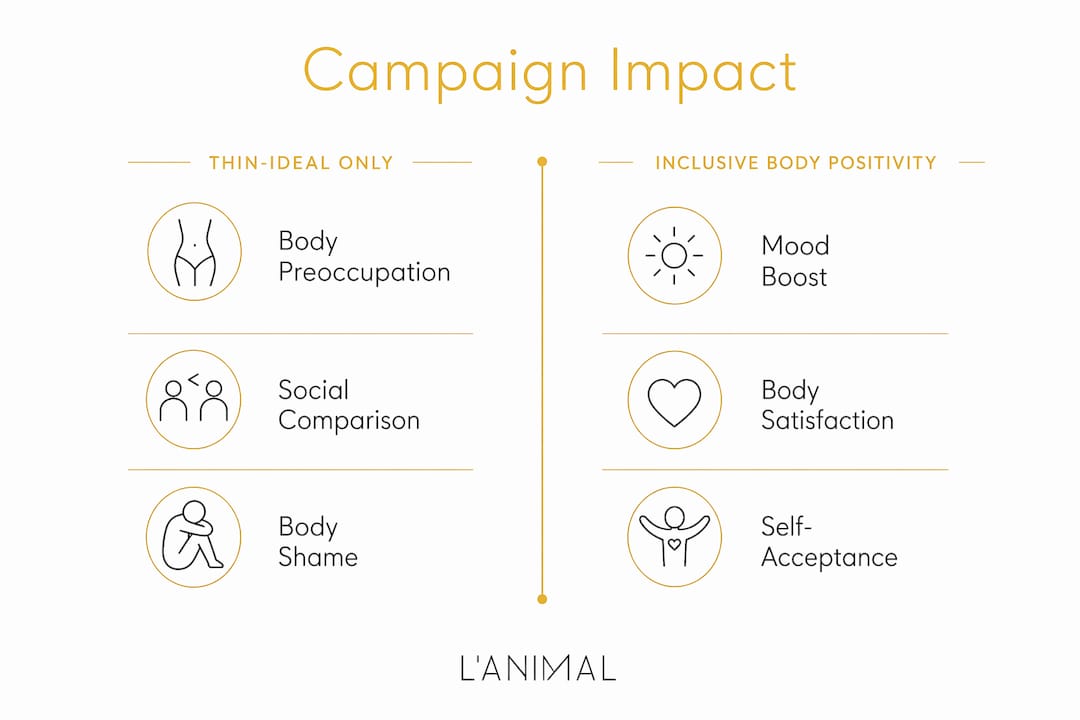
The table below compares representation strategies and their documented psychological outcomes:
| Representation approach | Psychological impact |
|---|---|
| Thin-ideal only | Increases body image preoccupation and self-objectification |
| Single “body-positive” body type | Partial benefit; excludes women with different builds |
| Multiple body types and shapes | Broadest reduction in self-discrepancy and body dissatisfaction |
| Functional style diversity (bust support, coverage options) | Signals practical inclusion, not just visual representation |
| Thinspiration or transformation framing | Actively worsens body image even when framed as positive |
A 2026 MDPI study on online exposure found that thin-ideal content worsens body image preoccupation in women, while body-positive content measurably mitigates that harm. The risk of “before and after” or transformation narratives is particularly high. These formats activate comparison thinking even when the intent is empowerment. Swimwear brands that avoid this framing entirely produce stronger psychological outcomes for their audience.
Social media comparison is also directly linked to body shame pathways, which makes the visual choices brands make on Instagram and TikTok more consequential than they might appear.
Choosing swimwear that supports body confidence starts with a shift in shopping criteria. Most women have been trained to shop for swimwear by asking “Will this make me look good?” The more useful question is “Will this let me forget I’m wearing it?”
Here is a practical framework for body-positive swimwear shopping:
Pro Tip: Read size guides carefully and measure yourself before ordering online. Swimwear sizing varies significantly between brands, and a brand that offers detailed fit notes is signaling that they have thought carefully about diverse body proportions.
What strikes me most about the 2026 research is how it confirms something I have observed through years of working in swimwear design and styling. Confidence in swimwear is not a personality trait. It is a design outcome. When a piece fits correctly, supports where support is needed, and moves with the body, the wearer stops thinking about the swimsuit entirely. That is the goal.
The industry has spent decades selling the idea that the right body is the prerequisite for the right swimwear. The research says the opposite. The right swimwear creates the conditions for confidence, regardless of body type. That is not a feel-good claim. It is a documented psychological mechanism.
What I find equally important is the self-discrepancy finding from Penn State. Representation without variety is not representation. A campaign that shows one “acceptable” version of a non-thin body is still telling most women they do not belong in the frame. True inclusion requires showing the full range of bodies that actually buy and wear swimwear, including athletic builds, petite frames, older women, and women with visible differences.
The challenge for the industry is that genuine inclusion requires investment in design, not just marketing. Scaling a pattern up does not produce a well-fitting plus-size garment. It requires rethinking proportion, support, and coverage from the ground up. That is harder and more expensive. But it is the only version of body positivity that actually works.
— Lital
At Lanimal, every piece is designed with fit and proportion as the starting point, not an afterthought. Designer Lital Simel-Rhedrick built L’ANIMAL on the principle that swimwear should support the body you have, not the body a size chart assumes you have.
The luxury one-piece collection features sculpting fits built for diverse body proportions, with adjustable details and supportive construction that let you stay present at the water’s edge. For those who prefer separates, the Watercolor Bikini Top and Sportif Bikini Bottom offer adjustable, comfort-driven options that work across a range of body types. Explore the full collection at Lanimal and find the piece that fits your body, your style, and your confidence.
Body positivity in swimwear is the practice of promoting inclusive representation, fit-focused design, and messaging that affirms all body types rather than reinforcing narrow beauty standards. It applies to both how brands market their products and how swimwear is physically constructed to fit diverse bodies.
Yes. A 2026 Frontiers in Psychology study found that brief exposure to body-positive swimwear ads increased positive mood, body satisfaction, and body appreciation in young women, while thin-ideal ads produced the opposite effect.
Research from Brainz Magazine (2026) explains that well-fitted swimwear removes constant bodily self-monitoring, allowing women to be present rather than preoccupied. Confidence comes from clothing that functions well, not from wearing a smaller size.
A genuinely body-positive campaign shows multiple body types, avoids transformation or thinspiration framing, and includes functional design diversity such as varied coverage and support options. A 2026 Penn State study found that representation benefits are strongest when viewers see bodies that closely match their own.
Yes. A 2026 Springer study with 197 women found that body-positive imagery improved mood and body satisfaction equally among women with and without histories of emotional abuse or bullying, confirming the benefit is not limited to women who already feel confident.
Body positivity in swimwear works through two independent mechanisms: inclusive representation that reduces self-objectification, and fit-focused design that removes bodily self-monitoring.
| Point | Details |
|---|---|
| Representation reduces self-objectification | Body-positive ads measurably improve mood and body satisfaction compared to thin-ideal content. |
| Fit matters more than size | Well-designed swimwear removes constant bodily attention, creating confidence regardless of size. |
| Variety in representation is required | Campaigns showing only one body type still exclude most women and limit psychological benefit. |
| Thinspiration framing actively causes harm | Transformation and before/after narratives worsen body image even when framed as empowering. |
| Design must address proportion, not just scale | Genuine inclusion requires rethinking support and coverage for diverse body proportions. |


