Free Shipping on US orders over $150
-
Collections
-
Bikini
- One Pieces
- Cover-Ups
- Men's
- Sale
- MODA GLAM x L'ANIMAL
- Nice Breed
-


Swimmers and anyone doing active water sports should choose lined trunks, ideally with a compression liner, for the support and coverage that mesh alone can’t match. Surfers and travelers moving between pool, lunch, and evening plans do better in unlined trunks that dry fast and pack light. L’ANIMAL’s double-layered pieces cover both cases with fabric built for fit, not just modesty.
TL;DR:
- Support and privacy are best achieved with compression liners for active water sports, while unlined trunks suit surfing and moving between different activities.
- Unlined trunks dry faster, feel lighter, and offer more range of motion, but they risk becoming see-through if made from thin or light-colored fabrics.
- Fabric choice and proper fit are essential, with stretchable liners, flat seams, and a snug waist supporting comfort and preventing chafing during prolonged wear.
- Rinse quick-dry fabrics after saltwater or chlorine, avoid dryers, and choose matte, heavy-weave fabrics to minimize transparency when wet.
- Activity type should determine trunk selection, with compression-lined styles preferred for swimming and active sports, and unlined or boardshorts better for surfing and casual wear.
The right pair depends on what you’re actually doing in them, not just what’s on sale. Before diving into liner types and fabric weights, here’s the short version:
The next sections break down exactly how mesh and compression liners differ, and when going without one actually makes sense.
“Lined” means there’s a second layer sewn inside the outer shell, and that layer comes in two main types. Mesh liners are the traditional option, a loose net of fabric that adds a little structure without much weight. They’re breathable, but they can bunch, trap sand at the beach, and rub against skin during long sessions in the water.
Compression liners are the newer standard. Built from stretchier, snugger fabric blends, they sit closer to the body like a built-in brief and reduce chafing while offering support similar to underwear. That snugness matters for anyone doing laps, treading water, or playing beach volleyball, where a loose mesh liner shifts around with every movement.
Pro Tip: Check the liner fabric blend on the product tag before buying. A compression liner with spandex content holds its shape wash after wash; a pure-mesh liner tends to stretch out and sag within a season.
Unlined trunks skip the inner layer entirely, which is exactly why they feel lighter and dry faster. Less fabric means less water retention, so you’re not walking around soaked for twenty minutes after you get out. That single-layer construction also moves more freely, which is why surfers and paddlers often lean toward it.
The trade-off is transparency. A thin or light-colored fabric can turn see-through when wet, and without a liner, there’s no second layer backing it up. Fabric weight and weave matter more here than in lined styles, since the outer shell is doing all the work.
If you want the breathability of unlined trunks without the modesty gamble, a quick-dry boardshort cut in a heavier weave solves most of the problem before you even get wet.
Matching trunks to what you actually do in them beats picking by looks alone. Here’s how to think through it:
The pattern holds across nearly every scenario: the more time you spend actually swimming, the more a liner earns its place. The more your day is about moving between activities, the more that liner becomes dead weight you’re better off without.
Sizing for lined trunks works differently than sizing for unlined ones. With a liner, you want a snug waist on the inner layer and a slightly looser outer shell, so the liner does the holding while the shell drapes naturally. With unlined trunks, the waistband and drawstring carry the entire job, so err on the snugger side rather than sizing up.
Underneath unlined trunks, quick-dry boxer briefs or compression shorts add a layer of support and reduce the transparency risk when trunks get wet. It’s a simple fix for anyone who’s had an unlined pair go sheer at exactly the wrong moment.
Pro Tip: Chafing happens from repeated skin-on-fabric friction, and medical guidance points to moisture control and fabric choice as the two biggest levers for preventing it. A dry, well-fitted liner beats any anti-chafe balm.
Liners trap moisture longer than a single layer does, which is exactly why odor and mild irritation show up more in lined trunks that get tossed in a gym bag wet. Modern quick-dry fabric blends push moisture out faster, but they still need a rinse after saltwater or chlorine exposure.
A heavier plain-weave outer fabric with a matte finish resists see-through moments far better than a thin, glossy one, and opaque pocket bags are a detail worth checking in product photos before you buy. Mid-rise cuts with a tailored leg opening tend to photograph and wear cleaner than baggy, low-rise styles.
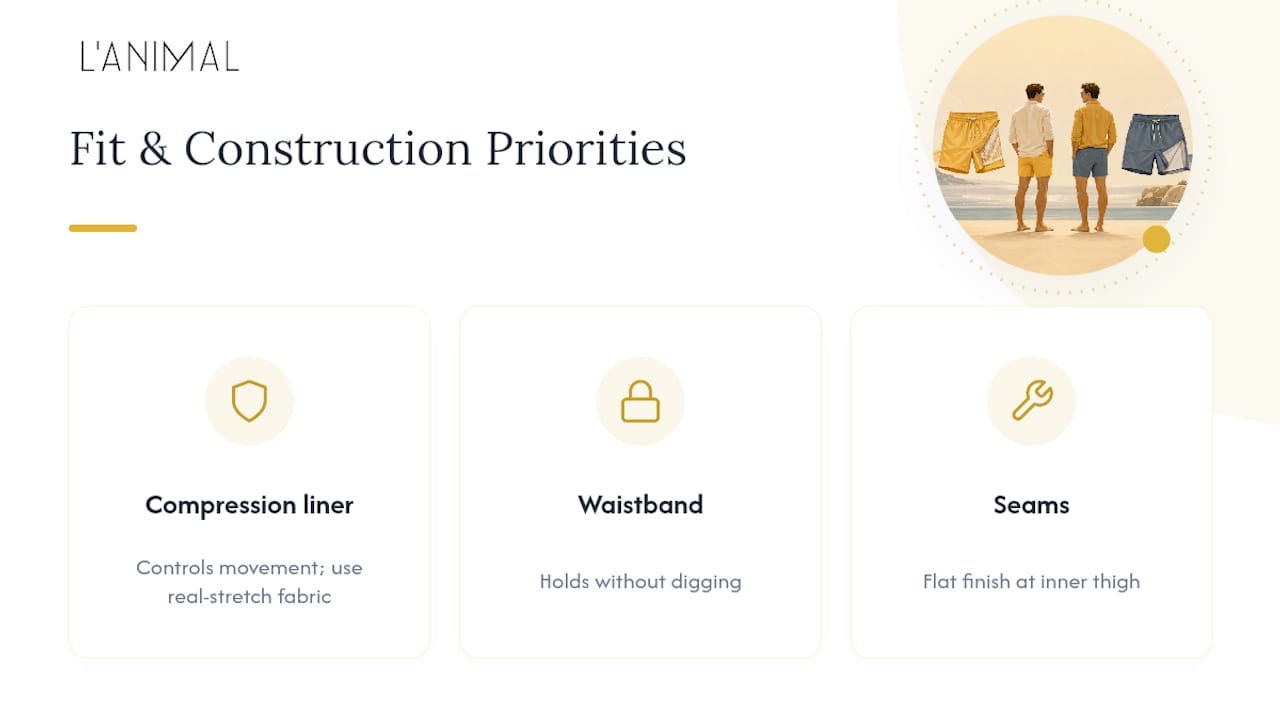
Lital Simel-Rhedrick designs L’ANIMAL’s trunks around the idea that fit comes from what’s underneath the outer fabric, not just the cut. That’s why double-layered construction shows up across the men’s collection: a compression liner controls movement while the outer shell keeps its shape. When shopping anywhere, prioritize three details: a liner fabric with real stretch, a waistband that holds without digging, and flat seam finishing at the inner thigh.
Swimmers and water-sport regulars should choose compression-lined trunks. Surfers and paddlers do better unlined or in a boardshort cut. Resort travelers and mixed-activity days call for a compression-lined pair in a heavier fabric that dries fast enough to double as street wear.
| Use Case | Recommended Style |
|---|---|
| Lap swimming / water sports | Compression-lined |
| Surfing / paddling | Unlined or boardshort |
| Resort / mixed days | Compression-lined, heavier fabric |
| Casual pool lounging | Mesh-lined |
Most guides treat lined and unlined trunks like a style choice, the way you’d pick a color or print. That misses the point entirely. The liner question is a performance question first, and I’d argue it’s the single most overlooked factor in how a pair of trunks actually feels three hours into a beach day.
The conventional advice, buy what looks good and hope it fits, skips the part that matters most: what your body is doing while you wear them. A guy doing cannonballs off a dock needs different support than one lounging poolside with a drink. Compression liners get treated as an upgrade everyone should want, but they’re wasted weight on someone who’s mostly walking between a lounge chair and the bar.
Prioritize the liner decision before the print or the color. Everything else, including how the trunks look wet, follows from getting that one call right.
— Lital
L’ANIMAL builds its men’s swim trunks around the same principle covered here: the liner and outer fabric have to work together, not just look good side by side. That means compression liners where support matters, matte-finish fabrics that resist transparency, and seam placement designed to reduce friction during actual movement, not just on a hanger.

If you’re shopping for a pair that handles both a swim and a walk to lunch, browse the full swim trunks collection and filter by construction to find a compression-lined style built for mixed-activity days. Every piece reflects the same design thinking Lital brings to fit: support where you need it, lightness where you don’t.


