Free Shipping on US orders over $150
-
Collections
-
Bikini
- One Pieces
- Cover-Ups
- Men's
- Sale
- MODA GLAM x L'ANIMAL
- Nice Breed
-


Tropical print fashion is defined as a clothing style built around bold, nature-inspired patterns featuring motifs like palm leaves, hibiscus flowers, pineapples, and exotic flora. The style creates a vibrant, breezy aesthetic associated with warm weather, resort wear, and island living. What separates tropical print clothing from other pattern categories is its direct reference to lush, equatorial plant life and its unapologetic use of saturated color. Understanding what is tropical print fashion means recognizing both its visual language and its cultural roots, which stretch from mid-century Italian resort wear to modern luxury runways.
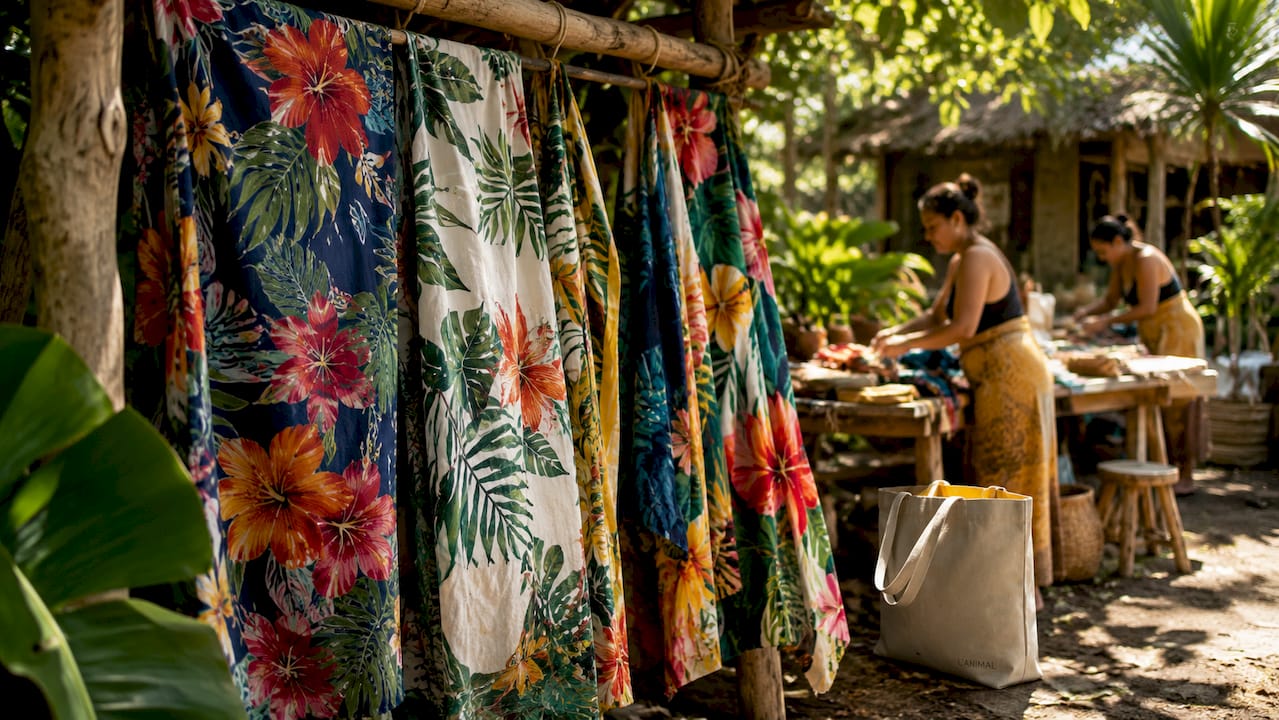
Tropical print fashion is built on a specific vocabulary of natural motifs. These motifs are what give the style its instantly recognizable character, whether you spot them on a maxi dress or a men’s button-down shirt.
The most common motifs include:
Hawaiian print is the most recognized sub-category of tropical fashion. It carries specific cultural weight, drawing from Hawaiian, Japanese, Chinese, and Western artistic traditions. Casual tropical fashion uses these motifs in repeating all-over patterns on cotton or viscose. Luxury tropical fashion takes a different approach, using abstract foliage interpretations and strategic placement rather than continuous repeats. The motif choice signals the occasion: a bold hibiscus repeat reads as beach-ready, while a hand-painted abstract leaf on silk reads as gallery-worthy.
Tropical print fashion has a traceable history that explains why it carries so much cultural weight today. The style did not emerge from a single source. It developed through overlapping influences across continents and decades.
1950s resort wear origins. Resort wear dates to the 1950s, when Italian designer Emilio Pucci introduced saturated prints for coastal holidays. His silk jersey pieces defined the Mediterranean version of tropical style, worn by the jet-set on the Amalfi Coast and in Capri.
The American-Caribbean branch. Alongside the Italian influence, a breezy cotton version of tropical fashion developed in the American-Caribbean market. This branch prioritized comfort and casual wearability over luxury, establishing the relaxed tropical print dress styles most shoppers recognize today.
The aloha shirt tradition. The global spread of tropical prints owes a significant debt to the Hawaiian aloha shirt. Hawaiian prints blended Hawaiian, Japanese, Chinese, and Western traditions, evolving from quilting fabrics and kimono textiles into a worldwide fashion symbol. The commercial success of the aloha shirt in the mid-20th century put tropical motifs on a global stage.
The luxury pivot. By the 2000s and accelerating through the 2010s, major fashion houses began treating tropical prints as a serious design medium. Luxury brands introduced metallic threads, hand-painted elements, and abstract foliage to move tropical prints from novelty to wearable art.
The 2026 moment. Tropical fashion now operates across all price points and all seasons. The style has shed its “summer only” limitation and appears in resort collections, fall transitional pieces, and year-round lifestyle wear.
This arc from Pucci’s silk jersey to today’s runway collections shows that tropical print fashion is not a trend. It is a persistent aesthetic category with genuine cultural depth.
The fabric choice in tropical print clothing is not incidental. It directly affects how the print reads, how the garment moves, and how comfortable it feels in warm weather.
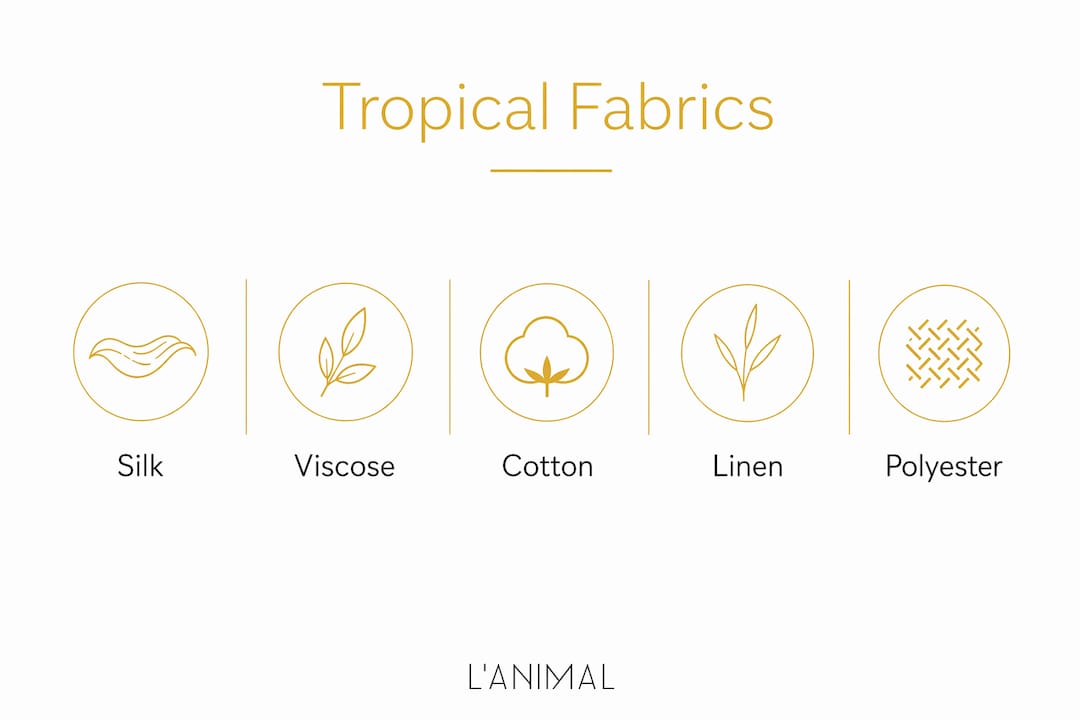
| Fabric | Key quality | Best use |
|---|---|---|
| Viscose | Lightweight, fluid drape | Maxi dresses, shirt dresses |
| Cotton | Breathable, structured | Casual shirts, shorts |
| Silk | Luxurious sheen, color depth | Luxury resort wear, blouses |
| Linen | Natural texture, airy feel | Relaxed trousers, cover-ups |
Viscose and cotton are the standard materials for everyday tropical print clothing. Viscose gives prints a seersucker-like texture and allows the fabric to drape loosely, which suits the relaxed silhouettes common in tropical fashion. Cotton provides structure and breathability, making it the go-to for casual shirts and shorts in warm climates.
At the luxury end, silk is the fabric of choice. Silk intensifies color saturation, which makes tropical prints appear more vivid and refined. High-end tropical fashion uses engineered placement prints on silk, positioning motifs deliberately on the garment rather than repeating them across the fabric. A single large palm leaf centered on the back of a silk blouse reads entirely differently from an all-over hibiscus repeat on cotton.
Pro Tip: When shopping for tropical print clothing, check the fabric content label before the print. A beautiful print on a stiff synthetic will look cheap in motion. Viscose and cotton move with the body and let the pattern do the work.
Styling tropical prints well comes down to one principle: restraint creates impact. The most common mistake is wearing too many competing elements at once, which turns a confident look into visual noise.
The core rules for wearing tropical prints:
For shoppers who want to build a tropical wardrobe gradually, start with a single tropical print piece and style it against a wardrobe of basics. A tropical print shirt dress over a white swimsuit, or a tropical print bikini bottom with a solid cover-up, gives you the aesthetic without the commitment. Lanimal’s approach to bold prints on vacation reinforces this: one strong print, worn with confidence, outperforms a head-to-toe themed look every time.
Pro Tip: If you want to mix two prints, make sure one is a micro-pattern (like a thin stripe or a small geometric) and one is the dominant tropical print. Keep the color palette shared between both pieces.
Tropical fashion trends in 2026 reflect a broader shift toward year-round wearability and elevated design. The style is no longer confined to summer or beach destinations.
The most significant current trend is the move toward abstract and artistic tropical motifs. Rather than literal hibiscus flowers, designers are working with painterly leaf shapes, oversized botanical prints, and color-blocked foliage. Tropical prints now serve as a canvas for designers, merging art and fashion in collections that feel closer to gallery exhibitions than seasonal resort lines.
Sustainability is also shaping how tropical print clothing is produced. Brands are moving toward natural fiber bases, including organic cotton and deadstock silk, to reduce the environmental cost of producing vivid, dye-heavy prints. This aligns with the core aesthetic of tropical fashion, which draws its identity from nature.
“The tropical aesthetic aims to evoke ongoing serenity and connection with nature, focusing on lightness and natural elements rather than superficial decoration. The most enduring tropical pieces are the ones that feel like they belong in the environment they reference.”
The multicultural foundation of tropical prints, shaped by Hawaiian, Japanese, and Chinese influences, continues to inform how designers approach the category. The best 2026 tropical fashion treats these roots as a source of depth, not just decoration.
Tropical print fashion is defined by nature-inspired motifs, breathable fabrics, and a cultural history that spans Italian resort wear, Hawaiian aloha traditions, and modern luxury design.
| Point | Details |
|---|---|
| Core definition | Tropical print fashion uses bold, nature-inspired motifs like palm leaves, hibiscus, and exotic flora. |
| Cultural roots | The style draws from Hawaiian, Japanese, Chinese, and Italian resort wear traditions dating to the 1950s. |
| Fabric matters | Viscose and cotton suit casual wear; silk and engineered placement prints define the luxury tier. |
| Styling principle | Anchor one tropical print piece with neutral basics to avoid over-theming and visual clutter. |
| 2026 direction | Abstract motifs, artistic interpretations, and natural fiber bases are driving the current evolution. |
I have worked with tropical prints long enough to say this with confidence: the style survives because it is genuinely connected to something people want to feel, not just look at. Most trend categories are built on novelty. Tropical print fashion is built on a mood. That is a much more durable foundation.
What I find most interesting is how the styling conversation has shifted. Ten years ago, the question was whether tropical prints were “too much.” Now the question is how to wear them with intention. That is a meaningful change. It means shoppers have moved past the novelty phase and are treating tropical prints the way they treat any other wardrobe category: as something to be styled thoughtfully, not just thrown on.
The mistake I still see constantly is over-theming. One strong tropical print piece, worn against clean neutrals, is striking. Three tropical pieces worn together become a costume. The 2026 influencer swimwear picks that perform best on social media are almost always the restrained ones: a single print, a confident silhouette, and nothing competing for attention.
Tropical print fashion has earned its place as a permanent aesthetic category. It is not going back to being a seasonal novelty.
— Lital
Lanimal was built around the idea that swimwear should carry the same design intention as any other fashion category. The tropical print pieces in the Lanimal collection reflect that directly: bold motifs, quality fabrics, and silhouettes that work on the beach and beyond.

The Sportif Bikini Bottom is a strong starting point for shoppers who want to bring tropical print into their wardrobe without overcommitting. Pair it with a solid cover-up or a neutral top and you have a complete look that holds up whether you are poolside or at a beachside lunch. Browse the full range of tropical-inspired swimwear to find pieces that match your style and the occasions you dress for.
Tropical print fashion is a clothing style defined by bold, nature-inspired patterns featuring motifs like palm leaves, hibiscus flowers, pineapples, and exotic birds. It is associated with warm-weather and resort wear but has expanded into year-round fashion at all price points.
Hawaiian print is a specific sub-category of tropical fashion with cultural roots in Hawaiian, Japanese, Chinese, and Western traditions. All Hawaiian prints are tropical, but not all tropical prints are Hawaiian.
Viscose and cotton are the standard choices for casual tropical print clothing because they are breathable and drape well. Luxury tropical pieces use silk, which intensifies color and suits engineered placement prints.
Wear one tropical print piece per outfit and pair it with neutral basics in white, sand, black, or olive. Repeat a color from the print in your accessories rather than adding a second pattern.
Tropical prints work year-round when styled correctly. Pair a tropical print blouse with tailored trousers in fall, or layer a tropical print piece under a solid blazer for transitional weather.


