Free Shipping on US orders over $150
-
Collections
-
Bikini
- One Pieces
- Cover-Ups
- Men's
- Sale
- MODA GLAM x L'ANIMAL
- Nice Breed
-


Choose adjustable straps because they let the product adapt to your body, instead of forcing your body to adapt to the product. A shoulder bag with a sliding buckle can drop into a relaxed crossbody position for travel days or sit higher and tighter when you’re moving fast through an airport. A sports bra with adjustable straps can be cinched tight for a run and loosened for restorative yoga, without owning two bras.
Before you buy anything with a strap, run two quick checks. First, the slider hold test: pull the strap taut and see if it slips back on its own. Second, match strap width to expected load. A one-inch strap on a heavy tote will dig in fast.
Adjustable straps outperform fixed straps for most everyday uses because they let the item conform to your body and activity instead of the reverse.
| Point | Details |
|---|---|
| Fit adapts to you | Adjustable hardware lets one bag, bra, or swimsuit fit multiple body positions and activities. |
| Hardware quality matters most | Metal sliders and corrosion-resistant finishes outlast plastic, especially in swim and daily-carry use. |
| Test before you buy | Pull the loaded strap for 10 to 15 seconds; slider creep now means failure later. |
| Fixed straps have a place | Minimalist designs and some high-movement athletic cuts still favor zero hardware. |
| L’ANIMAL builds in adjustability | Convertible straps and water-grade hardware appear across L’ANIMAL’s swimwear, including the Sportif Bikini Bottom. |
The strap material and the hardware holding it together decide whether adjustability actually works long term. Nylon webbing resists stretch and holds up in salt water and chlorine, which is why it shows up on quality swimwear and travel bags. Polyester is a step down in abrasion resistance but often feels softer against skin. Elastic straps flex with movement, which feels good on a padded bra strap but is the wrong choice anywhere you need the strap to hold a fixed length under load, since adjustable straps often deliver better long-term value specifically because the wearer, not the elastic, controls the tension.
Hardware matters just as much as fabric. Metal sliders and ladder locks outlast plastic ones, particularly on bags carrying real weight day after day. D-rings and swivel hooks that rotate freely prevent the webbing from twisting into an uncomfortable line. For swimwear specifically, look for hardware with a water-safe finish. Plain metal corrodes fast once salt water gets into the mechanism.
Pro Tip: Before buying, pull the loaded strap and hold it under tension for 10 to 15 seconds. If the slider drifts even slightly, that’s the failure mode you’ll be dealing with in six months, not a one-time fluke.
The advantages of adjustable straps shift depending on what you’re wearing or carrying, and treating every strap the same way is where most buying decisions go wrong.
No, and pretending otherwise oversimplifies a real design tradeoff. Adjustable straps win on versatility, fit correction across different bodies or activities, and extended usable life since you can compensate for material stretch instead of retiring the item. But every slider and ladder lock is a moving part, and moving parts can creep, twist, or eventually fail.
Fixed straps still make sense in specific situations:
The honest answer to “are adjustable straps better” is that they’re better for fit flexibility and longevity, and fixed straps are better when simplicity and zero hardware failure risk outweigh the need to adjust.
Run through this checklist before you buy, whether you’re standing in a store or scrolling a product page online.
The stakes are higher than they look for one category in particular. Industry write-ups on fit cite estimates that 70 to 100 percent of women wear the wrong bra size, a range wide enough to suggest that a fixed, one-size strap setting is rarely going to land correctly on any given body.
Care matters after purchase too. Rinse swimwear hardware in fresh water after ocean or pool use to slow corrosion, and avoid machine-washing anything with metal sliders unless the tag specifically allows it. If a slider stops holding tension even after a firm pull, or webbing starts fraying near the hardware, that’s your sign to replace the strap rather than keep fighting it.
L’ANIMAL was founded by designer and stylist Lital Simel-Rhedrick, and the brand’s swimwear reflects a specific point of view on straps: they should adjust to the wearer’s body across a full day, not just fit correctly in a fitting room mirror. That shows up in convertible strap options across the collection and a preference for water-grade hardware that holds its grip through pool chlorine and ocean salt, the same wet-performance concern covered in the materials guidance on wet swim straps earlier in this piece.
Strap width is a styling decision as much as a functional one, as explained in How straps shape support and sex appeal in lingerie. A thinner strap reads as more delicate on a slight frame, while a wider strap offers more support and a bolder silhouette for an active build. Readers curious about how this plays out across a full collection can see the range in L’ANIMAL’s adjustable swimwear designs.
If a strap doesn’t move with you through a full day at the beach, in and out of the water, adjusting for a photo, adjusting to sit down, it isn’t doing its job. Adjustability isn’t a feature we add. It’s the baseline we design from.
Most buying guides treat adjustable straps as a checkbox feature, something to confirm exists rather than something to actually test. That’s backward. A strap with a slider is only better than a fixed strap if the slider holds. I’ve seen plenty of bags and bras marketed around adjustability where the hardware is the weakest part of the product, which defeats the entire purpose.
The conventional advice to “just look for adjustable straps” also skips the tradeoff conversation entirely. There are real situations where fixed straps are the smarter design choice, and pretending adjustable is always superior does readers a disservice. What actually matters is matching hardware quality and strap width to your specific load and activity, then testing the mechanism before you trust it.
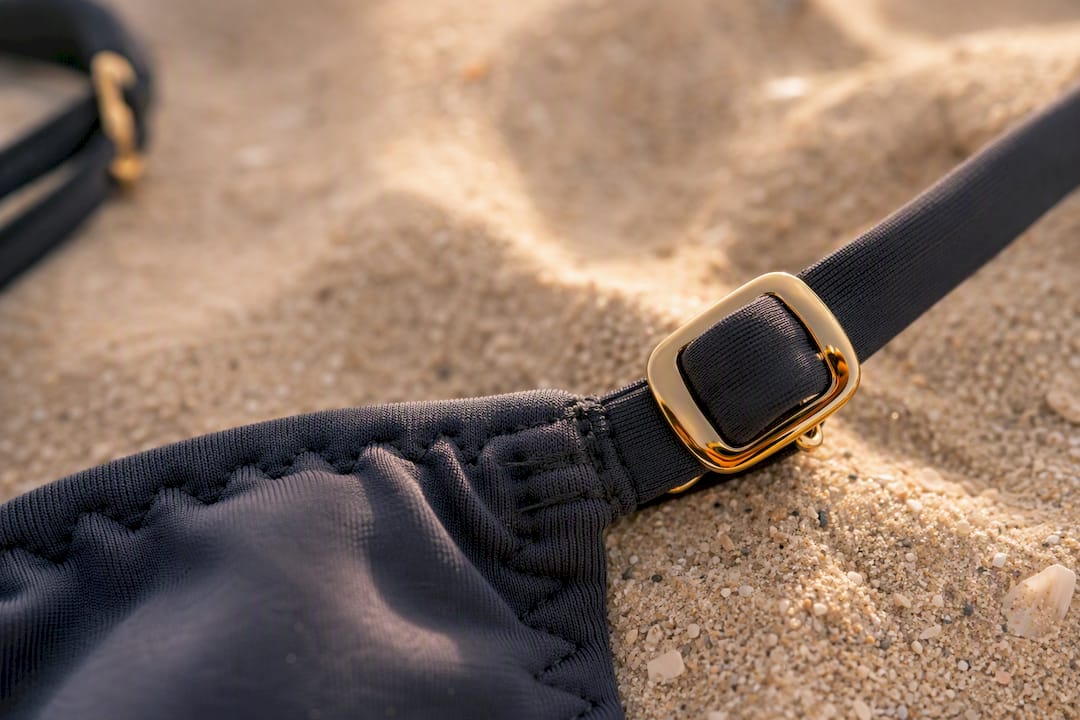
If you take one thing from this: prioritize the pull test over the spec sheet. A strap that claims a generous length range but slips under real tension isn’t adjustable. It’s just loose.
If you’ve made it this far, you already know what separates a well-built adjustable strap from a gimmick: hardware that holds, materials that survive salt water, and a fit that moves with your actual day at the beach or pool. That’s the standard L’ANIMAL designs to, not an afterthought bolted onto a finished suit.

The Sportif Bikini Bottom reflects that approach directly, built with water-grade hardware and strap options that adjust to your body rather than asking you to adjust to the suit. If you’re deciding between styles, L’ANIMAL’s guide on finding the right bikini for your body type is a useful next stop before you check sizing and add a piece to your cart.
Why choose adjustable straps over fixed ones? Adjustable straps let a bag, bra, or swimsuit fit your body across different activities and outfits, correct for material stretch over time, and extend the usable life of the item versus a strap that’s set once and never changes.
Are adjustable straps better for sports bras? For high-impact activity, non-stretch adjustable straps with independent tensioning on each side generally give better support than elastic straps, since elastic tends to loosen mid-workout.
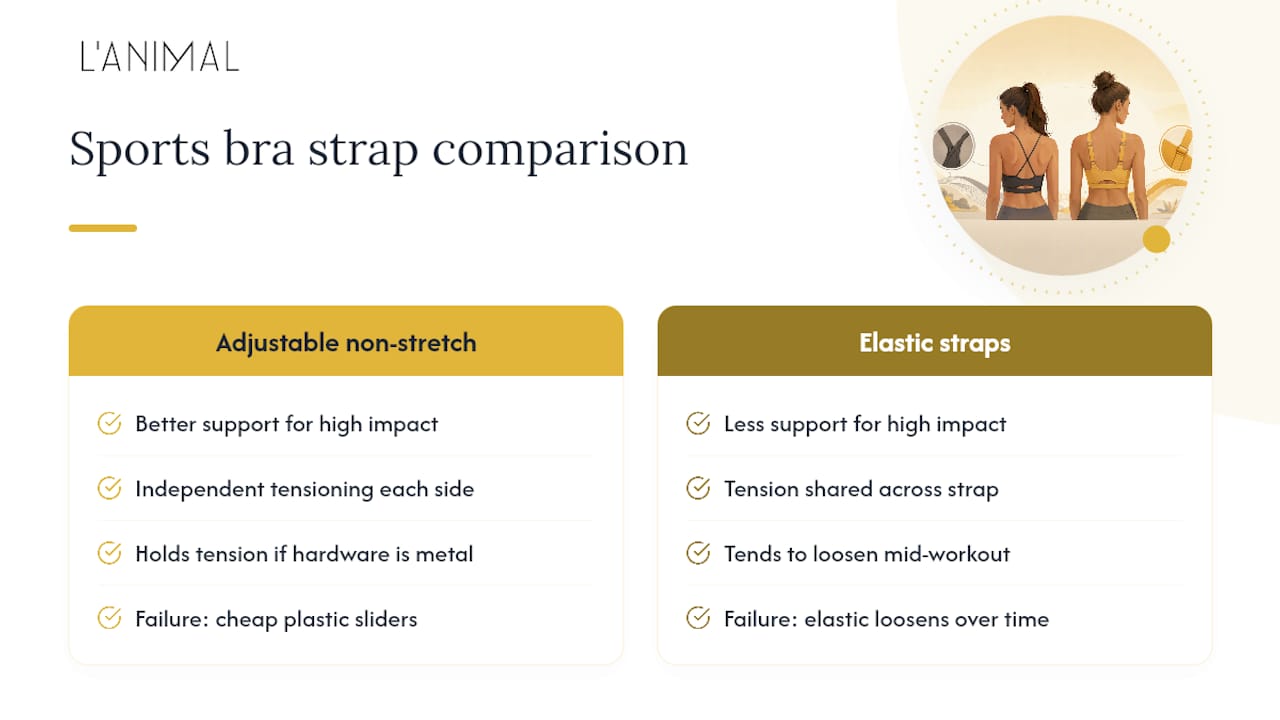
Do adjustable straps wear out faster than fixed straps? Not usually, provided the hardware is metal or a reinforced water-safe finish. The failure point is almost always cheap plastic sliders, not the concept of adjustability itself.
What strap width should I look for on a bag? Match width to weight. Light bags can use a narrow strap comfortably, but anything carrying real daily load needs a wider strap to avoid shoulder digging.
How do I know when to replace an adjustable strap? Replace it once the slider stops holding tension under a firm pull, or once webbing near the hardware starts to fray. Both are signs the mechanism, not just the fabric, has worn out.


