Free Shipping on US orders over $150
-
Collections
-
Bikini
- One Pieces
- Cover-Ups
- Men's
- Sale
- MODA GLAM x L'ANIMAL
- Nice Breed
-


Cutouts in bikinis have a reputation for being purely eye candy. You see them on influencer feeds, on runways, and on the resort pages of fashion magazines, and the assumption follows that they exist to show more skin. But that framing misses a significant shift happening in swimwear design right now. Modern cutout bikinis are engineered with fit stability, pressure distribution, and fabric recovery in mind. This article breaks down how cutout construction actually works, what separates a well-made cutout from a flimsy one, and how to shop for a style that holds up well past the first pool session.
| Point | Details |
|---|---|
| Cutouts blend style and function | Modern bikinis use cutouts not just for looks but to enhance fit and movement. |
| Engineering is critical for support | Proper construction ensures cutout swimwear provides stability, especially during active use. |
| Beware common fit pitfalls | Poor cutout design can lead to gaping and rolling, so choose bikinis with tested structural features. |
| Smart shopping maximizes confidence | Knowing which details to look for will help you select stylish, comfortable cutout bikinis that last. |
| Demand more than trends | Ask about engineering and multi-size testing to ensure your bikini delivers both fashion and function. |
Cutout swimwear started as a high-fashion statement. Designers used strategic material removal to create visual drama on the runway, playing with negative space and silhouette in ways that translated immediately to editorial spreads and red carpets. The practical application came later, and it required real engineering effort to get right.
Today, the most forward brands treat cutouts as structural decisions, not just aesthetic ones. The placement of a cutout changes how the surrounding fabric behaves. A side cutout on a one-piece, for example, shifts the way the torso fabric distributes tension across the body. Brands that understand this engineer their garments around those shifts rather than simply punching holes in existing patterns.
Key reasons cutouts have moved from purely decorative to technically considered:
As noted by Delfina Athletics, cutout suits can still be suitable for performance and training when the overall construction maintains stability. Support in these designs comes from the full garment system, including liners, structure, strap security, and shape retention, not from tightness alone. That distinction matters a lot when you are shopping.
Understanding the custom bikini benefits of purpose-built swimwear helps explain why off-the-rack cutout styles often underperform. Generic patterns are rarely tested across the full range of movement a cutout demands. If you use a standard bikini shopping checklist before buying, you are already ahead of most shoppers.
Cutout placement is a structural commitment. Every hole in a swimsuit changes where the remaining fabric works hardest. The brands doing it right treat each cutout as an engineering variable, not a decoration.
Once a brand commits to including a cutout, the construction decisions cascade quickly. The fabric surrounding the cutout takes on more responsibility. The edges need finishing that prevents rolling, curling, or fraying. The straps or panels that connect across the cutout become the primary load carriers for that region of the body.

Research published in 3D fashion design modeling confirms that garment pressure and comfort depend on how designs allocate pressure across body parts. Accurate fit modeling must also account for fabric behavior in wet conditions, which becomes especially relevant for cutout styles where material removal changes fit and contact patterns. In short, a bikini that fits well dry may behave very differently once it is saturated with pool water.
Here are the core construction factors that determine cutout performance:
| Construction feature | Impact on cutout fit | Risk if absent |
|---|---|---|
| Internal liner | Shape stability | Transparency, sagging |
| Bound elastic edge | Prevents rolling | Curling, distortion |
| Reinforced strap anchor | Load distribution | Strap pull-out, gaping |
| High-recovery fabric | Long-term shape retention | Stretched look after washing |
| Tested seam paths | Even tension | Stress tears near cutout |
Understanding ruching in swimwear offers a useful parallel. Just as ruching gathers fabric to create fit and coverage, cutout construction removes fabric precisely to achieve the same goals from the opposite direction. Both techniques demand that the surrounding construction does more work.
Pro Tip: When evaluating a cutout bikini, gently stretch the fabric near the cutout edge and release. It should snap back immediately and fully. Slow or incomplete recovery is an early sign the suit will look stretched and worn after minimal use.
The sculpting fit details used in quality one-piece construction are a good benchmark for what cutout finishing should feel like in practice.
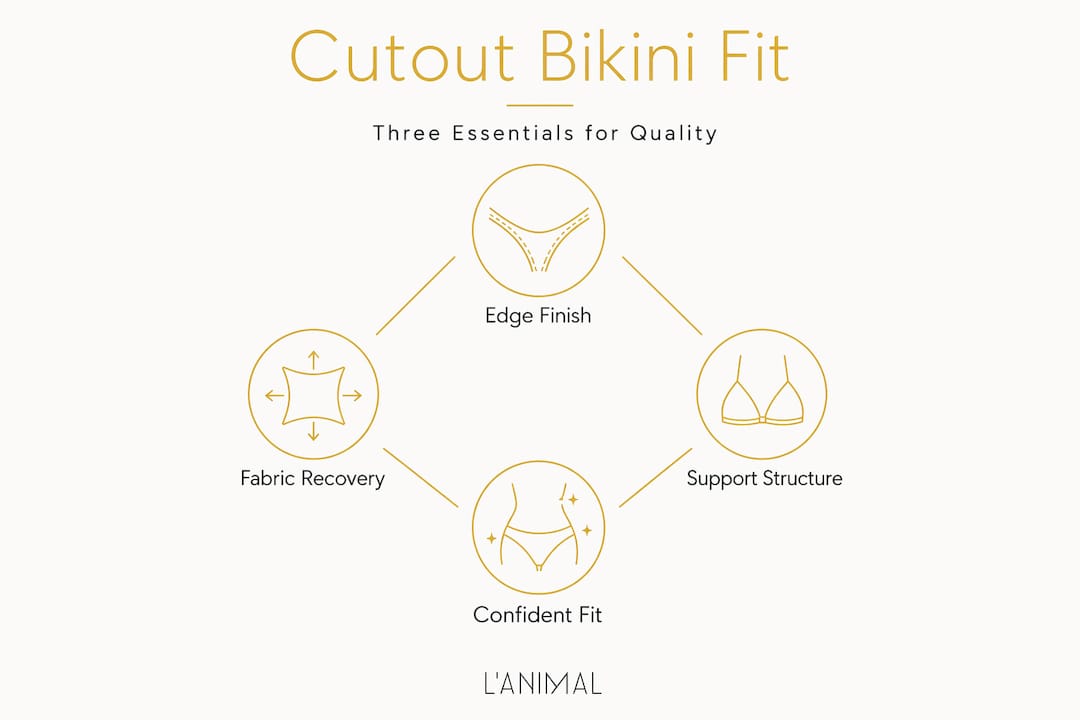
Poor cutout design fails in predictable ways. Knowing what to watch for helps you avoid wasting money on swimwear that looks worn out before summer is half over.
Common cutout problems:
According to Joy Sportwear, key edge cases for cutouts include proportion across sizes, gaping, rolling, growth after repeated wear, and behavior when wet. Brands that do this right validate their designs with multi-size sampling and stretch-and-recovery testing rather than approving a single sample size on a dry fit alone.
Additionally, elastic binding in swimwear is directly tied to functional outcomes. Using more or fewer supportive binding details changes how support redistributes around a cutout, affects whether edges gap or shift, and determines how long the garment holds its original geometry.
| Design approach | Outcome | Longevity |
|---|---|---|
| Bound elastic edges | Clean, stable perimeter | High |
| Serged raw edges | Acceptable initially | Medium, degrades faster |
| Unfinished edges | Immediate rolling | Low |
| Multi-size validated pattern | Consistent fit across sizes | High |
| Single-sample approved pattern | Unpredictable fit scaling | Variable |
Practical shopping strategies:
The beachwear fit guidance provides a useful starting framework. And if you want a bottom that holds up through active wear without sacrificing style, the construction behind performance bikini bottoms offers a practical reference point.
Pro Tip: When in doubt, size up in cutout styles. A slightly larger garment with high-recovery fabric will hold its shape and still fit well after repeated wear. A tight fit in a low-recovery fabric will look stretched within weeks.
With a solid understanding of what makes cutout construction work, you can now make a genuinely informed choice. Shopping with these criteria in mind moves you from guesswork to precision.
As Joy Sportwear points out, treating cutout placement and edge finishing as an integrated system, combining cut geometry with reinforcement, elastic binding, and stable seam paths, is what produces an elevated look that still feels securely engineered. That framing is exactly right.
Exploring bikini tops with these criteria in mind is a very different experience than browsing by color alone. And if support is a primary concern, the underwire bikini guide covers how structured support systems interact with cutout styling for those who need additional reinforcement.
Here is the honest problem with most cutout swimwear coverage. It starts and ends with aesthetics. Which body types look best in which cutout placements. Which colors are trending. Which influencer wore what. None of that is useless, but it skips the part that actually determines whether you will wear the suit three times or thirty.
The deeper issue is that most shoppers have no framework for evaluating construction quality before they buy. They rely on photos, which show a dry garment on a single body type, photographed in ideal lighting. That tells you almost nothing about how the suit will perform in chlorinated water after twelve pool sessions.
The custom swimwear wisdom behind purpose-built design addresses this gap directly. When a brand designs with real multi-size fit testing and fabric recovery validation as non-negotiable steps, the result is a garment that actually looks the way it does in the photo when you wear it. That is a higher bar than most trend-driven swimwear reaches.
The uncomfortable reality is that many cutout styles on the market are constructed to photograph well, not to wear well. Thin fabric, minimal edge finishing, and single-size pattern approval are shortcuts that show up immediately on the body in real conditions.
What shoppers should be asking is not “does this look good on the model” but “what fabric recovery rating does this use, how are the cutout edges finished, and was this tested across multiple sizes.” Those are the questions that predict whether a bikini holds up. The more brands hear those questions from informed shoppers, the faster construction standards improve across the market.
If this breakdown has shifted how you think about cutout bikinis, the next step is seeing those principles in real garments designed with genuine construction standards.

At L’ANIMAL, every piece is designed with the kind of attention to structure, fabric quality, and fit detail this article has covered. From luxury one-piece swimwear with engineered cutout panels to individual pieces like the Watercolor Bikini Top and the Sportif Bikini Bottom, the collection is built for wearers who expect their swimwear to hold its shape, sit securely, and look exactly as good on the beach as it does in the photo. Browse the full range and find a cutout style that works for your body, your activity level, and your personal aesthetic.
Yes, when engineered properly with secure straps, liners, and full garment structure, cutout bikinis can provide stability comparable to traditional swimwear designs.
Fabric behavior changes significantly when wet, which is why quality construction must account for wet conditions to ensure shape retention and prevent gaping or excessive stretch.
Look for reinforced elastic binding, stretch-and-recovery tested fabric, and stable seam finishing around perimeters, as multi-size sampling ensures these features work across all body types, not just sample sizes.
Yes, with thoughtful placement and proper fit validation across sizes, cutout styles can be flattering for various shapes, especially when patterns are tested rather than scaled from a single sample.
Well-made cutouts with reinforced binding and quality fabric maintain their shape and durability over time. Poorly finished edges are the primary cause of early distortion and wear.


