Free Shipping on US orders over $150
-
Collections
-
Bikini
- One Pieces
- Cover-Ups
- Men's
- Sale
- MODA GLAM x L'ANIMAL
- Nice Breed
-


A crochet cover-up outfit is a beachwear layer built from open, handmade or hand-look stitching that skims over a swimsuit without fully hiding it. Buy one if you want ready-to-wear simplicity and a designer finish. Make one yourself if you want to control the length, yarn, and fit down to the stitch.
TL;DR:
- Choose a crochet cover-up style that matches your intended activity, such as mini dresses for pool parties or kaftans for lounging.
- Prioritize lined versions or add a slip to achieve sufficient coverage, especially if you plan to wear the piece beyond beach hours.
- Evaluate fabric content and stitch quality carefully online, with attention to gauge, lining, and construction details to avoid poor fit or durability issues.
- DIY crochet cover-ups are cost-effective and customizable, but require gauge testing, appropriate materials, and finishing steps like blocking and weaving in ends.
- Accessories and styling choices, such as footwear and layering with structured pieces, significantly enhance the versatility of crochet cover-ups for transitioning from beach to street.
Crochet cover-ups aren’t one silhouette. They’re a family of shapes, and picking the wrong one for your plans is the most common reason a $60 piece ends up folded in a drawer after one trip. Match the style to what you’re actually doing that day, not just what looks good on a hanger.
The crochet mini or shift dress sit at the top of most shopping lists because it does the most work with the least effort. Pull it over a bikini, add sandals, and you’re dressed for a beach bar in under a minute. The shift cut (straight through the body, no waist definition) flatters almost every frame because it doesn’t cling anywhere it doesn’t need to. Look for one that hits mid-thigh to knee if you want versatility beyond the sand. Shorter hemlines lean toward pool-party energy; longer ones read more “brunch appropriate.”
The maxi kaftan is the cover-up equivalent of a security blanket. Loose, floor-grazing, and usually finished with wide dropped sleeves, it’s built for lounging by the pool or walking the boardwalk without worrying about wind or coverage. Because the fabric floats away from the body, it works well for anyone who wants ease without sacrificing style. The tradeoff: it’s not a great pick if you’re layering over pants later, since the volume gets bulky under trousers.
The two-piece crochet set (a cropped top paired with a matching skirt or shorts) give you more mixing potential than any other style on this list. Wear the top alone over a bikini for a beach walk, then swap the bottom for denim shorts once you’re off the sand. It’s the most versatile option for anyone who wants one purchase to stretch across multiple outfits, though it demands a bit more coordination than a one-and-done dress.
The sarong or pareo isn’t technically crochet in most cases, but it belongs in this conversation because stylists frequently pair it with crochet pieces for texture contrast. Vogue’s styling coverage points out that sarongs work as a wrap skirt, a shoulder scarf, or even a strapless top, which makes them one of the most flexible pieces you can pack. If you already own a crochet two-piece, a sarong tied at the hip adds coverage without adding bulk.
The mesh tunic trades traditional yarn-based openwork for a fishnet-style knit that mimics the crochet look with a lighter hand. It drapes closer to the body than a chunky crochet piece, which makes it a strong choice if you want the aesthetic without the bulkier texture. This is the category some mesh dress cover-ups sit in: a crochet-inspired silhouette with a sleeker profile than hand-hooked yarn work.
The crochet skirt, usually paired with a bikini top or a simple tank, gives you bottom-half coverage while keeping your top half free for a swimsuit reveal. It’s a smart pick for anyone who wants to transition from swim to street without a full dress change.
Here’s how those styles break down by use case:
Lined versus unlined matters more than most shoppers realize. An unlined piece shows your swimsuit through every gap in the stitch, which is the intended look for pool lounging but can feel too revealing for a restaurant patio. A lined version (usually a slip dress or built-in liner) gives you the crochet texture with actual coverage underneath, making it the better choice if you plan to wear the piece past sunset.
Buying online means you’re judging fabric, drape, and fit from photos alone, and crochet is unusually easy to misjudge that way. A few minutes spent reading the product description carefully saves you a return shipment.
Material tradeoffs come first. Cotton crochet breathes well and feels soft against sunscreen-covered skin, but it absorbs water and dries slowly, which is a real consideration if you’re wearing it straight out of the pool. Acrylic and polyester blends dry faster and hold their shape better over repeated wear, though some cheaper synthetic yarns feel noticeably scratchier than cotton, especially against damp skin. If a listing doesn’t specify fiber content, treat that as a small warning sign rather than an assumption in your favor.
Construction quality shows up in the details you can zoom into. Hand-crocheted pieces have slightly irregular stitch spacing and visible knots where yarn was joined; machine-made crochet-look knits are more uniform but sometimes stiffer. Neither is automatically better, but the price should reflect which one you’re getting. A tighter gauge (smaller stitches, less open space) creates a more structured piece that holds its shape; a looser gauge drapes more but stretches more too.
Here’s a quick checklist to run through before you check out:
Retailers ranging from large marketplaces to boutique swim labels carry an enormous range of crochet cover-up dresses at wildly different price and quality tiers, which is exactly why the checklist above matters more here than with a simple cotton tee. Two dresses can look nearly identical in a thumbnail image and differ completely in hand-feel and durability once they arrive.
Pro Tip: Zoom into the product photos and look specifically at the stitchwork close-ups most listings include. Tight, even stitches with clean joins usually signal better construction than loose, uneven gaps, even before you read a single review.
Sizing deserves its own note because crochet doesn’t behave like woven fabric. It has give in every direction, so a piece labeled “one size” might genuinely fit a range of body types, or it might stretch out of shape after two wears if the yarn is low quality. When in doubt on sizing, size down slightly for structured crochet and stay true to size for looser, more elastic knits.
If you’d rather build your own piece stitch by stitch, the beginner crochet world is generous with free patterns, and you don’t need advanced skills to finish something wearable in a weekend or two.
Start with these free patterns, each suited to a slightly different skill level and finished look:
Materials matter as much as the pattern itself. Beginner tutorials commonly recommend 100% cotton yarns such as Lion Brand Pima Cotton, which several published patterns specify by name alongside hook size and approximate yardage needed. For a mini dress or tunic-length piece, expect to need a moderate amount of yarn depending on size and gauge, plus a hook size that is typically medium, around 4mm to 5.5mm. Cotton blends with a touch of acrylic hold their shape better over repeated washing than pure cotton, if durability matters more to you than natural fiber content.
Gauge is the step beginners skip and regret. Before diving into the full pattern, crochet a small swatch, roughly 4 inches square, and measure it against the pattern’s stated gauge. If your swatch comes out smaller than specified, your tension is tight and you should size up your hook. If it’s larger, size down. Skipping this step is the single most common reason a finished cover-up ends up too small or oddly proportioned. Patterns that publish clear gauge and yardage numbers help beginners sidestep this pitfall entirely, so favor those over vague “make it your size” instructions when you’re starting out.
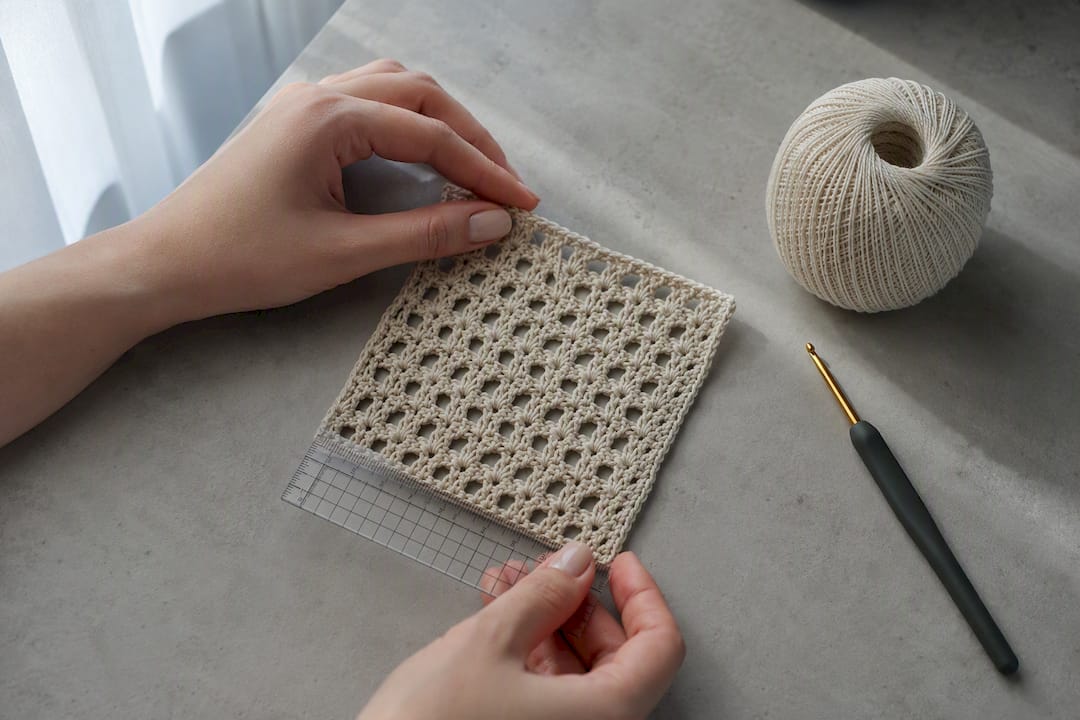
To adjust length or width mid-project, add or subtract full stitch repeats rather than partial rows, since crochet lace patterns rely on repeating motifs that break visually if cut short.
Finishing steps that separate an amateur look from a polished one:
On time investment: a simple sarong wrap can realistically be finished in a weekend by a true beginner. A fitted mini dress with shaping typically falls into advanced beginner or intermediate territory and can take one to three weeks of evening crochet sessions, depending on gauge and how often you pick it up. Pattern roundups that categorize by skill level are worth checking before committing to a project if you’re working against a vacation deadline.
The real value of a crochet cover-up shows up when it stops being “beach only” and starts pulling double duty for the rest of your trip. A few formulas make that transition automatic instead of something you have to figure out on the fly.
Sand-to-street outfit recipes:
Accessory rules matter more with crochet than with most fabrics, because the open stitchwork already reads as texture-heavy. Keep jewelry either minimal (a few thin gold chains) or intentionally chunky (large hoops, a statement cuff) rather than a scattered mix of both. Vogue’s styling advice around sarongs and wraps notes that natural-texture accessories like raffia bags pair especially well with openwork pieces, since the woven texture complements crochet instead of competing with it. A layered jewelry approach works particularly well over a crochet mini dress, where the skin peeking through the stitches gives jewelry room to actually show.
Footwear does more heavy lifting than people expect. Flip-flops keep a look firmly in beach territory, which is fine for a lounge day but reads too casual for a beach-to-bar transition. Swap to espadrille wedges or leather slide sandals the moment you’re heading somewhere with a hostess stand, and the same crochet dress suddenly looks intentional rather than thrown on.
Mixing crochet with structured pieces is an underused trick. A crochet two-piece top over tailored linen trousers creates a contrast between loose, handmade texture and a sharper silhouette, which reads more “resort evening” than beachwear. Denim shorts underneath a crochet mini dress, worn as an open topper, gives you a completely different daytime look from the same piece. For more full outfit breakdowns built around this kind of mixing, L’ANIMAL’s guide to sheer and openwork beachwear walks through several sand-to-street combinations in detail.
Pro Tip: Pack one crochet piece as a “hero item” for the trip and build two or three different looks around it using only accessory swaps. It stretches your suitcase space and photographs differently each time.
Crochet is more fragile than it looks, and the biggest threat to a good piece isn’t the ocean. It’s the washing machine and a careless suitcase.
On sizing: remember that crochet stretches with wear and with humidity, so a piece that feels slightly snug on day one often relaxes into a better fit by day three of a trip. If you’re between two sizes, sizing down usually serves you better for a longer-lasting fit than sizing up and watching a loose piece stretch even further.
Lital Simel-Rhedrick, designer and stylist behind L’ANIMAL, built the brand around swimwear and resortwear that hold their shape past the first wear. Crochet cover-ups get judged on drape and durability more than almost any other beachwear category, since open stitchwork snags and stretches faster than woven fabric if the construction is careless.
Some designer approaches prioritize finishing details that reduce snag points: secure yarn joins, consistent gauge across a piece, and lining choices that add coverage without weighing down the drape. Proportion matters just as much as fabric. A cover-up cut too long overwhelms a smaller frame, while one cut too short can undercut the point of coverage entirely. The goal with every piece is a silhouette that reads intentional on the beach and still looks finished once you’re off it.
Price ranges for crochet cover-ups swing widely, and the gap usually comes down to construction method rather than brand name alone. Mass-market synthetic-blend pieces from large retailers often sit at the lower end, while hand-finished cotton crochet from boutique swim labels sits considerably higher. Marketplace listings spanning thousands of crochet cover-up styles show this range firsthand: near-identical silhouettes priced differently based on fiber content, lining, and finishing quality.
Budget-conscious shoppers can find serviceable acrylic-blend cover-ups at accessible price points, though these tend to show wear faster after repeated sun and salt exposure. Mid-range pieces, usually cotton or cotton-blend with better-finished seams, offer a stronger balance of cost and longevity for anyone planning to wear the piece across multiple seasons rather than a single trip. Designer pieces at the top of the range typically justify the cost through construction quality: tighter, more even stitch gauge, secure yarn joins, and lining options that make the piece wearable beyond the pool.
If you’re making your own, the math shifts entirely toward yarn cost. A cotton yarn like Lion Brand Pima Cotton in the yardage range needed for a mini dress runs modestly compared to a finished retail piece, making DIY the more budget-friendly route if you already own a hook and have the time to invest. The tradeoff is time, not just money: a handmade piece costs less in dollars but considerably more in hours.
Crochet cover-ups follow the same seasonal rhythm as the rest of swimwear, with new colorways and silhouettes typically arriving in retail collections ahead of peak summer months. Retail category pages organize crochet cover-ups into core collections, new arrivals, and trending sections, which signals how actively the category turns over compared to more static wardrobe basics.
Neutral tones like cream, sand, and off-white remain a consistent baseline because they pair with virtually any swimsuit color underneath. Beyond the neutrals, expect warmer, saturated shades like terracotta, burnt orange, and deep coral to dominate in-season palettes, alongside crisp white for a cleaner resort look. Pastels tend to trend for spring transition pieces, while richer jewel tones show up more in late-summer collections as retailers pivot toward transitional resort wear.
Texture trends move alongside color. Chunkier, more visibly hand-hooked crochet has been gaining ground against the finer, tighter gauge that dominated for several seasons, giving shoppers more variety in how “handmade” a piece looks regardless of whether it actually is. Mesh-crochet hybrids sit at the intersection of both trends: they read as crochet-inspired while offering a sleeker drape that doesn’t tie you to one specific texture trend cycle. For seasonal outfit inspiration built around current colorways, L’ANIMAL’s guide to upgrading beach looks breaks down what’s trending piece by piece.
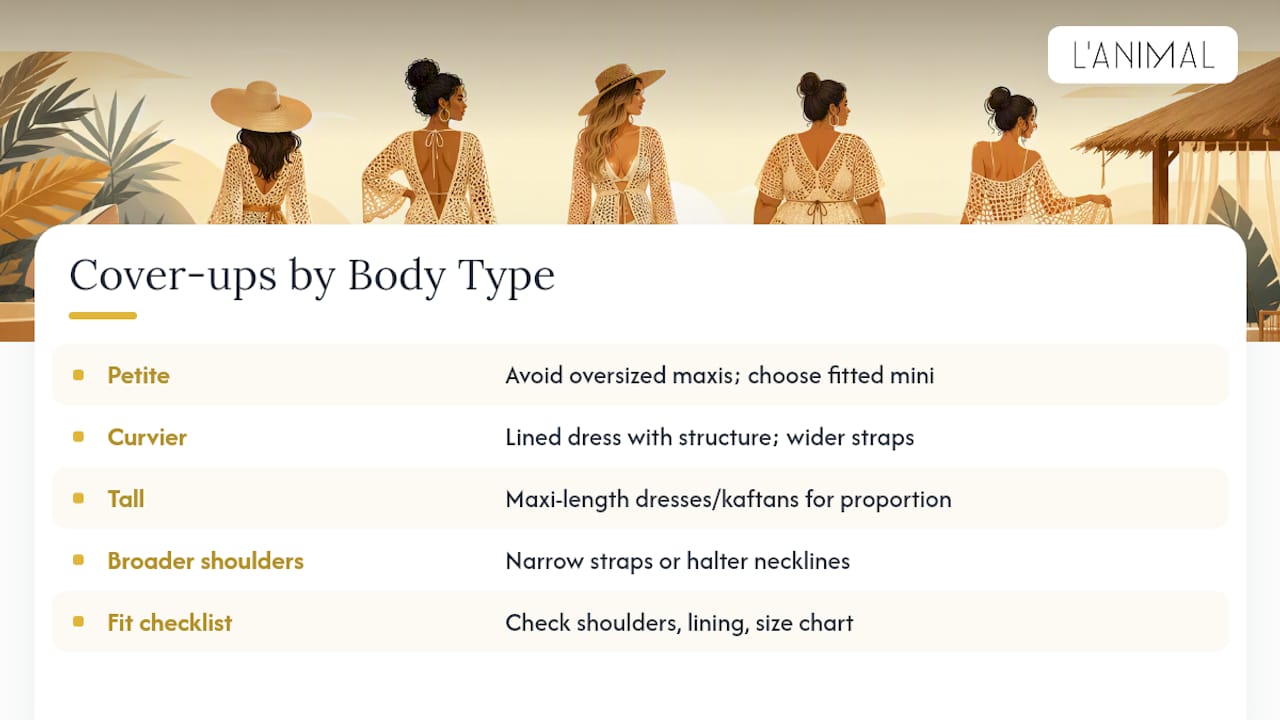
The best crochet cover-up is the one that fits your proportions and how you plan to wear it, not a universal “flattering” style that ignores your actual body.
If you’re petite, avoid oversized maxi caftans that can visually swallow a smaller frame. A fitted crochet mini dress or a two-piece set with a defined waist keeps proportions balanced, and a shorter hemline (above the knee) tends to elongate the leg line.
If you’re curvier through the hips and bust, a lined crochet dress with some structure through the bodice offers support that a fully open, unlined piece can’t. Look for wider straps and a defined waistline rather than a boxy shift, which can add volume in the wrong places. A kaftan with a tie-waist option also gives you the choice to cinch or leave loose depending on the day.
If you’re tall, maxi-length kaftans and longer crochet dresses tend to look proportionate rather than overwhelming, since there’s enough vertical space for the silhouette to drape properly. Petite-cut pieces can run short on a taller frame in ways that feel accidental rather than intentional.
If you’re broader through the shoulders, skip styles with wide, structured sleeve openings that add horizontal width up top. A tunic or dress with narrower straps or a halter-style neckline balances proportions better.
Regardless of body type, the fit-checklist from the buying-guide section above (checking shoulder and sleeve openings, confirming lining, and reading actual body measurements against the size chart) matters more than any general body-type rule. Crochet’s natural stretch means the same size can fit two different body shapes very differently depending on where the piece is cut generously versus close.
Crochet cover-ups show up across several distinct retail categories, and knowing which one you’re browsing sets your expectations before you even click into a product page.
Large general marketplaces carry the widest volume and price range, from budget synthetic-blend pieces to mid-tier cotton options, all searchable in one place. The tradeoff is inconsistency: quality varies dramatically between nearly identical-looking listings, which is why the photo-inspection checklist from the buying guide matters most here.
Boutique swim and resortwear labels, including L’ANIMAL, typically focus on a tighter, curated selection with more attention to construction, lining, and finishing detail. Expect fewer options to scroll through but generally more consistency in fiber content and fit, since the brand controls production more directly than a marketplace aggregating third-party sellers.
Department store and multi-brand retailers sit in between, carrying a rotating selection of named swimwear brands alongside private-label crochet pieces. This category is useful if you want to compare a few established labels side by side without hunting across multiple individual brand sites.
Fast-fashion retailers move seasonal crochet trends to market quickly and at low prices, but construction quality is the first thing sacrificed for speed. These pieces work well for a single trip or short-term wear, less well as a long-term wardrobe investment.
Retail collection structures, like the core, new-arrival, and trending groupings boutique swim labels use, give you a sense of how a brand curates its crochet offering, which is worth checking before you commit to browsing a full catalog.
If you’ve read this far and still aren’t sure whether to buy or make your own, the Amour Mesh Dress Cover-Up from L’ANIMAL solves the “which style do I even pick” problem by combining crochet-inspired texture with a sleeker mesh drape that works from pool lounging straight through to dinner. It’s designed by Lital Simel-Rhedrick with the same attention to proportion, finishing, and drape covered throughout this guide, so you’re not stuck guessing whether a listing photo matches what actually arrives.
The dress layers easily over a bikini for beach days and stands on its own for beach-to-bar evenings, which means one purchase covers more of your trip than a single-use piece. Pair it with a statement raffia bag and simple sandals, and you’ve got a full outfit without assembling five separate pieces. Browse the Amour Mesh Dress Cover-Up on L’ANIMAL’s site and check current sizing and availability before your next trip.
Buy when you want a specific look ready before a trip, and let a piece like L’ANIMAL’s Amour Mesh Dress Cover-Up handle proportion and finishing decisions for you. Make one when the process itself appeals to you, or when you can’t find a silhouette that fits your exact body type off the rack.
Either way, the one rule I’d want every reader to leave with: openwork crochet needs a plan for what’s underneath it. A cover-up without a lining strategy, whether that’s a slip dress, a coordinating bikini, or an intentional layering piece, always looks unfinished no matter how good the stitchwork is. Get that part right first, then build the rest of the outfit around it.
— Lital


