Free Shipping on US orders over $150
-
Collections
-
Bikini
- One Pieces
- Cover-Ups
- Men's
- Sale
- MODA GLAM x L'ANIMAL
- Nice Breed
-


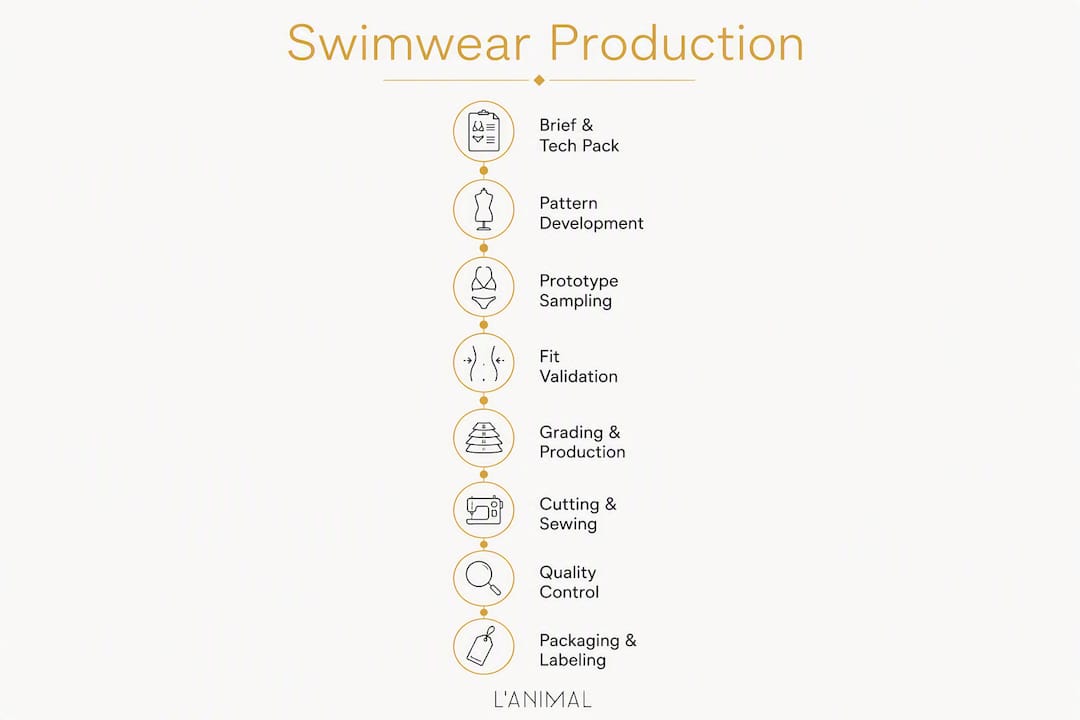
The full mens swimwear workflow runs in nine stages: (1) brief and tech pack, (2) pattern development, (3) prototype sampling, (4) fit validation, (5) grading, (6) production preparation, (7) bulk production with inline QC, (8) final inspection, and (9) packing and shipping. For a typical small-batch launch, expect several months from first prototype to bulk delivery.
The workflow spans design input through fulfillment, covering every decision that turns a sketch into a retail-ready garment. Each stage has a clear owner and a defined deliverable.
Stakeholders by stage:
Private label vs. full custom development changes the workflow at the pattern stage. Private label uses a factory’s existing block, which shortens development by 2–4 weeks but limits fit customization. Full custom development starts from a brand-owned block, giving complete control over rise, leg opening, and waistband geometry. For a brand like Lanimal, where fit precision and aesthetic detail define the product, full custom is the standard path.
Primary deliverables at each stage:
Lanimal’s collection drop planning reflects this structure, with each style moving through defined gates before it reaches the customer.
The tech pack is the single source of truth for production. It translates design intent into factory-executable instructions, covering flats, bill of materials (BOM), measurement specs, elastic mapping, stitch callouts, artwork placement, and tolerances. Structured input before sampling reduces late-stage changes and improves quote accuracy.
A well-developed swimwear tech pack enables factories to execute three core steps: develop accurate prototypes, calculate precise MOQs and unit prices, and schedule assembly lines with QC reference points.
Required tech-pack items:
For first projects, a minimal tech pack covers items 1–5. The ideal level adds items 6–9 and reduces sample rounds by eliminating factory guesswork.
Pro Tip: Keep all tech-pack files in a single versioned project folder, named by style and revision number (e.g., TRUNK-01_v3). Freeze the folder after PP approval and require written sign-off for any post-approval change.
Pattern engineering for swimwear must be built for stretch and recovery, not simply scaled from woven garment rules. The fabric’s elongation behavior determines every seam placement, ease decision, and elastic length.
Pattern development process:
Standard grading fails for high-stretch knits because flat-mm increments do not account for how the fabric behaves under tension. Grade using stretch percentages: define how much negative ease the fabric supports at 30% and 50% elongation, then apply those percentages to each point of measure across sizes. The measurements to control most carefully are leg opening circumference under tension, waist elastic tension, and front rise under stretch.
Pro Tip: Photograph the prototype on the fit model from front, back, and side, and annotate the images directly with measurement notes. This visual record prevents misinterpretation when communicating changes to an overseas factory.

Pick materials by performance priorities first: stretch and recovery, wet opacity, chlorine resistance, and hand feel. Appearance follows from those constraints, not the other way around.
| Fabric | Stretch/Recovery | Wet Opacity | Print Fidelity | Chlorine Resistance |
|---|---|---|---|---|
| Nylon-spandex | Excellent | Good | Moderate (reactive/digital) | Good |
| Polyester-spandex | Good | Excellent | Excellent (sublimation) | Excellent |
| Recycled nylon-spandex | Good | Good | Moderate | Good |
| Recycled polyester-spandex | Good | Excellent | Excellent | Excellent |
Elastic selection: Elastic mapping must specify width, tension, and application method for every location. Waistband elastics for men’s trunks typically have a moderate width for support; leg opening elastics are narrower to prevent rolling. Chlorine-resistant, latex-free elastics are the standard for performance swimwear.
Printing methods:
Sustainability note: Recycled fabrics can affect dye uptake and stretch behavior compared to virgin equivalents. Always test a strike-off on the recycled fabric, not a virgin substitute, before approving colorways.
Sampling is iterative. Plan at least 2–3 purposeful rounds and define what each must validate before the next begins.
Sampling sequence:
Fit-testing checklist:
Who runs tests: A fit model at the target size, with a QA inspector capturing measurements before and after wear. Document feedback in writing with annotated photos, not verbal notes.
Pro Tip: Run a chlorine soak test (30 minutes in a standard pool-concentration solution) and a wet opacity check on at least one fit sample before PP approval. Color shift and transparency failures caught here cost nothing to fix; caught after bulk production, they cost everything.
Grading for swimwear uses stretch-aware rules. Specify stretch percentages and test-referenced increments rather than flat-mm steps, because static grading leads to fit loss when garments are worn stretched.
Grading process:
Marker and lay planning:
Grading adjustments that differ from woven rules:
Cost depends mostly on fabric choice, print complexity, number of colorways, and order quantity. MOQs vary by supplier but can be negotiated, especially for new brands.
Cost drivers:
Smaller production runs can be negotiated in early stages to keep capital liquid. Ask factories about minimums per style vs. per order, staggered color breaks, or paying for strike-offs to reduce risk on print-heavy styles. Starting with a pilot run of a limited colorway before committing to a full size set is a practical way to test demand without overextending inventory. For deeper context on why quality investment pays off at retail, see Lanimal’s guide on swimwear quality and value.
Typical small-batch timeline:
| Stage | Duration |
|---|---|
| Tech pack finalization | 1–2 weeks |
| Prototype development | 2–3 weeks |
| Fit sample revisions (1–2 rounds) | 2–4 weeks |
| PP sample and sign-off | 1–2 weeks |
| Bulk production | 4–6 weeks |
| Final inspection | 3–5 days |
| Shipping (sea freight, US) | 3–5 weeks |

Active manufacturers typically list sampling at 2–3 weeks and bulk production at 4–6 weeks after sample approval. Sea freight to the US adds 3–5 weeks; air freight compresses that to under a week at significantly higher cost. AI-powered allocation platforms can align inventory quantities with seasonal demand patterns, which helps set order quantities before committing to bulk.
Bulk production must follow the approved PP sample exactly. Set clear inspection gates before cutting begins and maintain them through final inspection.
Production checkpoints:
AQL basics for stretch garments: AQL (Acceptable Quality Level) sets the maximum defect rate acceptable in a shipment. For swimwear, AQL 2.5 is standard for major defects (measurement out of tolerance, seam failure, print misplacement); AQL 4.0 covers minor defects (light thread tails, minor color variation). Tighter checks (AQL 1.0) are warranted for hero styles, high-unit-price pieces, or any style with a complex print or hardware component. Sewing swimwear uses specialized stitches and elastic application methods; stitch choice directly affects stretch durability and seam behavior under repeated stress.
Sample inspection data table:
| Check | Method | Pass Criteria |
|---|---|---|
| Measurements | Tape measure, relaxed and under tension | Within ±6mm of approved spec |
| Seam integrity | Pull test, visual inspection | No skipped stitches, no thread breakage |
| Elastic tension | Stretch and release, measure recovery | Consistent hold, no rolling or gaping |
| Print placement | Overlay against approved artwork template | Within ±5mm of placement guide |
| Wet opacity | Submerge in water, photograph | No visible skin tone through shell and lining |
| Hardware security | Pull test on all sliders, rings, hooks | No movement or detachment |
QC checklist for brands:
Confirm all private-label elements during sampling so packaging and labeling match the approved PP sample. Rework after bulk packing is expensive and delays shipping.
Packaging checklist:
Logistics checklist:
For seamless construction styles, folding instructions matter more than for standard cut-and-sew, since improper folding can distort the fabric’s shape in transit.
The most common failures in men’s swimwear production are insufficient tech-pack detail, skipping controlled fit tests, and ignoring print distortion on stretch fabrics. All three are preventable with disciplined checkpoints.
Best-practices checklist:
Lessons from production failures:
Pro Tip: Centralize all project files in a shared folder, freeze the folder after PP approval, and require a written change request for any post-approval modification. A single undocumented change to elastic tension after PP sign-off can produce a bulk run that fails the fit check.
A precise tech pack, at least two documented fit rounds, and written PP sign-off are the three steps that most directly determine whether a men’s swimwear production run succeeds or requires costly rework.
| Point | Details |
|---|---|
| Build a complete tech pack first | Include elastic mapping, stitch callouts, and artwork placement before requesting factory quotes. |
| Run two or more fit rounds | Document each round with measurements and annotated photos; structural issues cannot be caught by spec sheets alone. |
| Use stretch-aware grading rules | Grade using stretch percentages at each point of measure, not flat-mm increments. |
| Require strike-offs for all prints | Approve prints on the exact production fabric, not digital proofs, to catch color shift and placement distortion. |
| Lanimal’s workflow standard | Lanimal applies fit-block approval, print strike-off sign-off, and PP sample sign-off as non-negotiable gates for every style. |
The single non-negotiable in a premium swimwear workflow is fit validation on body, not on paper. A measurement sheet can show a garment within tolerance and still produce a trunk that gaps at the leg, rolls at the waistband, or loses coverage under movement. Those failures are invisible until a real person wears the garment in real conditions.
At Lanimal, the balance between aesthetics and performance shapes every tech-pack decision. A print placement rule is not just a visual choice; it determines whether the hero motif survives the grading process intact. An elastic specification is not just a construction note; it determines whether the waistband holds its position after 50 wears in saltwater. These decisions are made at the tech-pack stage, not corrected at the QC stage.
Lanimal’s per-launch checklist:
If you need designer-engineered men’s swimwear without managing the production workflow yourself, Lanimal offers pieces built to the same standards described in this guide: precise fit blocks, performance fabrics, and quality-checked construction.
Lanimal’s men’s swim collection is designed by Lital Simel-Rhedrick and produced with the same fit-validation and material standards outlined above. Each piece ships retail-ready, with no sampling rounds, no MOQ negotiations, and no production lead time on your end. For a reference point on what designer men’s swim trunks look like at the market level, the range of silhouettes and construction approaches available gives useful context for positioning your own line.
Browse the Sportif Bikini Bottom and the full Lanimal collection to see how these production principles translate into finished pieces. This is a ready-made alternative to custom production, not a substitute for it.


